
Thanks for your support! If you make a purchase using our links in this article, we may make a commission. And, as an Amazon Associate, I earn from qualifying purchases. See the full disclosure here.
Published June 15, 2023 | Last updated September 1, 2026
If you are wondering whether a deer whistle can keep a deer from running in front of your RV, I would not count on it.
I understand why people buy them. Hitting a deer can do a lot of damage, and in an RV the consequences can be even worse because of the size of the vehicle and the amount of glass and fiberglass up front.
I have seen that firsthand.
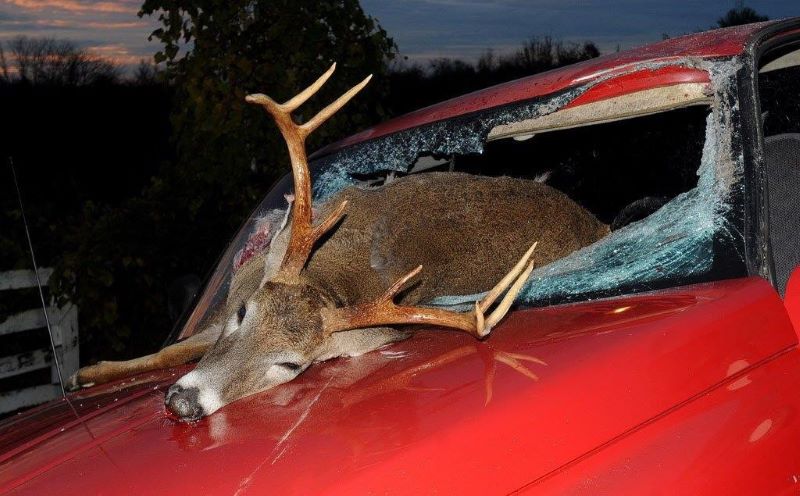
My father-in-law once had a well-antlered buck jump into the path of his truck camper on a four-lane highway. The deer crashed into the window, the glass shattered, and antlers came through the cab. He had minor injuries and the cab-over section was damaged.
I have also hit a deer myself while driving a Ford Explorer. It took out the front grille and damaged the radiator underneath. In my case, there was no time to swerve, honk, or do much of anything.
Neither vehicle had a deer whistle. The bigger question is whether a whistle would have changed anything.
Based on the research we have today, I would not rely on one.
Do Deer Whistles Really Work?
The short answer is that the evidence does not show deer whistles reliably prevent deer-vehicle collisions.
A study published in the Journal of Wildlife Management tested sounds within the known hearing range of white-tailed deer using a vehicle-mounted sound system. The researchers found that the sounds did not change deer behavior in a way that would prevent collisions.
Other reviews of deer-collision prevention methods have reached the same general conclusion: deer whistles are not supported by strong evidence as an effective deterrent.
That does not mean every deer will ignore every sound. Deer are unpredictable. It means you should not treat a whistle as a safety device you can depend on.
How Are Deer Whistles Supposed to Work?
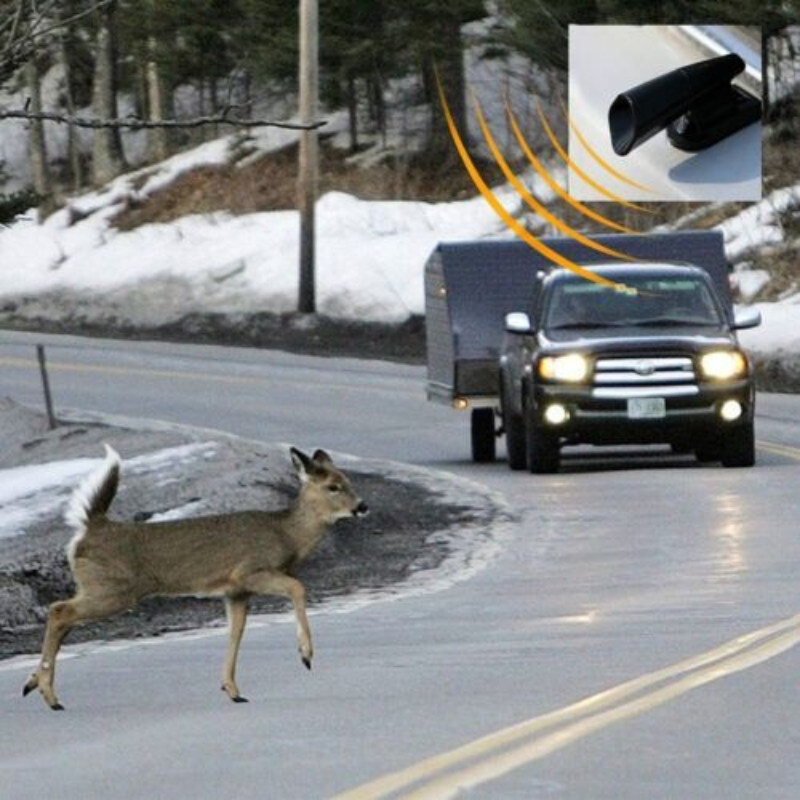
Most deer whistles are small air-powered devices mounted on the front of a car, truck, or RV. As the vehicle moves, air passes through the whistle and creates a high-frequency sound.
The theory is that deer hear the sound and move away from the road before the vehicle reaches them.
The problem is not just whether the whistle makes noise. The real question is whether that noise consistently causes a deer to move in a safer direction. Research has not shown that it does.
And that matters because a startled deer does not always run away from traffic. It may freeze, turn around, or run directly across the road.
Would I Put a Deer Whistle on an RV?
I have never used a deer whistle on an RV or vehicle, so I cannot give you a personal product review.
If someone wants to install one because it is inexpensive and makes them feel like they are adding another layer of caution, that is their choice.
But I would not drive any differently because it is there.
I would still assume a deer can step into the road at any time, because that is the part you can actually control: your speed, your attention, and your reaction.
How to Reduce Your Chances of Hitting a Deer in an RV
The best protection is defensive driving.
AAA recommends being especially alert around dawn and dusk because deer are more active during those times. I would also slow down anytime you are driving through wooded areas, near fields, or anywhere you see deer-crossing signs.
Use your high beams when there is no oncoming traffic so you have a better chance of spotting reflective eyes or movement near the shoulder.
If you see one deer, assume there may be more behind it. Deer often travel in groups, and the second or third deer may be the one that ends up in front of you.
This is even more important in an RV because you need more distance to slow down than you would in a passenger car.
Should You Honk at a Deer?
I would not make honking your main strategy either.
Some driving-safety guidance suggests a horn may help move a deer out of the road, while other guidance points out that loud sounds can be unpredictable around wildlife.
My takeaway is simple: if you have time, slow down first. Do not assume the deer will react the way you want it to.
In my own deer collision, I had no time to honk anyway.
If a Deer Runs in Front of Your RV, Do Not Swerve
This may be the most important part of the whole article.
If a collision becomes unavoidable, brake firmly, hold the steering wheel, and stay in your lane.
Swerving can turn a deer collision into a much worse crash by putting you into oncoming traffic, off the road, or into a tree or guardrail.
That is especially serious in a motorhome or while towing a trailer because sudden steering inputs can destabilize a much heavier vehicle.
Wear your seat belt, keep both hands on the wheel, and give yourself as much stopping distance as possible.
What Should You Do After Hitting a Deer?
If you do hit a deer, get as far off the roadway as you safely can and turn on your hazard lights.
Check everyone in the RV or tow vehicle for injuries first.
Do not approach or try to move the deer. An injured animal can still kick or strike with its antlers.
Call law enforcement if the animal is blocking the road, there are injuries, or the crash needs to be reported under local law.
Take photos of the scene and damage when it is safe to do so, and contact your insurance company if you need to make a claim.
Before driving away, look carefully for damage to the radiator, cooling system, lights, windshield, tires, body panels, and anything hanging loose underneath. A vehicle that still runs is not automatically safe to continue driving.
Are Deer Collisions More Dangerous in an RV?
They can be.
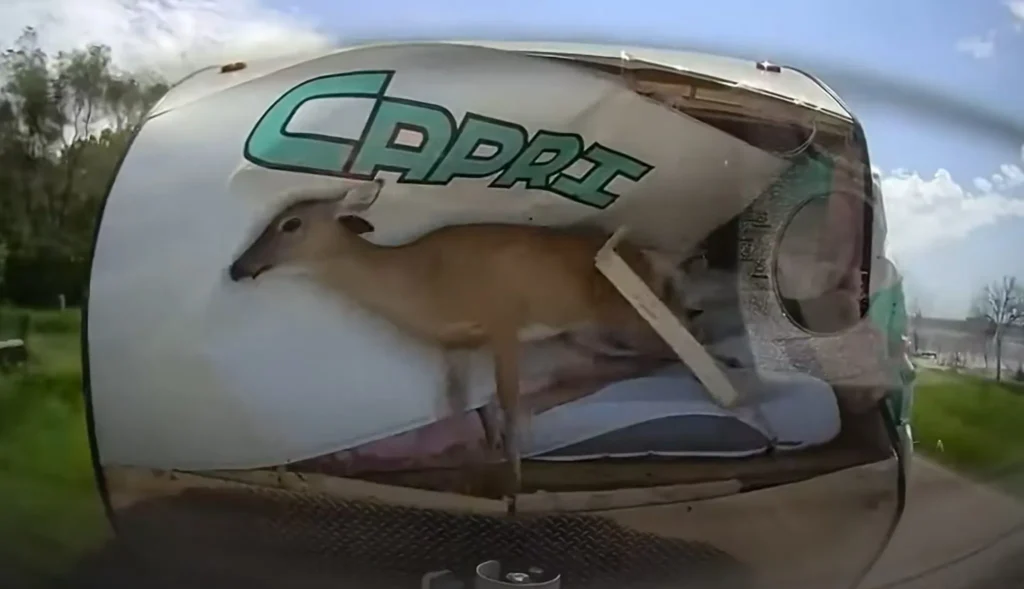
A large motorhome may have a big windshield and fiberglass front cap that can be expensive to repair. A tow vehicle pulling a trailer also has more mass and takes longer to slow down.
That is one more reason I would rather reduce speed and improve reaction time than depend on a small whistle mounted on the front of the vehicle.
My Bottom Line on Deer Whistles
I know how quickly a deer collision can happen.
My father-in-law’s truck-camper accident and my own collision with a deer both happened fast enough that there was very little time to react.
That is exactly why I would not put much faith in a deer whistle.
The research does not give me a good reason to believe one will reliably keep deer out of the road.
I would rather slow down, stay alert at dawn and dusk, watch the shoulders, use high beams when appropriate, expect more deer after seeing the first one, and avoid swerving if a crash is unavoidable.
Those are the things I would trust.
Related Reading
6 Best Tips to Drive Your RV Safely at Night
Does Insurance Cover RV Windshield Replacement?
Terri Nighswonger – Author and Full Time RVer
Terri Nighswonger and her husband Todd have been RVing and work camping for six years with their Cavalier King Charles Spaniel, Newton, and their Minnie Australian Shepherd, Remi. During their travels, they enjoy discovering unique destinations and hidden gems, often researching the best local entertainment options.
In Addition to the RVBlogger team, Terri has written for RV Life and RV Camping Magazine and is always excited to talk about her passion for RVing and her knowledge and experience in work camping.
Writing is Terri’s passion, but she also loves hiking, kayaking, walking her dogs, and anything she can do outdoors.
They originate from the Midwest but plan to enjoy the West for a few years, wintering in Arizona and summering wherever the road may lead.

put in the brightest amber fog lights u can get. Has worked for over 20 years in deer valley MT.
Had 3 encounters before I put on my car, now on my M/H we watch them look at us when we drive by them.
The deer whistles worked kind of when I was a kid on my Dad’s car but not really! It’s not just forested areas that have a lot of deer….farmlands seem to be worse.
You have a lot of great suggestions and I think everyone will do well to follow all of them. From my experience with and without deer whistlers, before my wife and I started using deer whistlers on our cars, trucks, and our RV, I hit my first deer. It was about dusk, and I didn’t have time to react. The speed limit was 55 and that was what I had my cruise set to. I was lucky it only damaged the bumper. The deer was propelled about 150 feet and off to the side of the road. My wife had hit several deer before we looked into putting deer whistlers on all of our vehicles along with changing our driving habits we haven’t hit a single deer to date. I thought I would mention that the first deer I hit there were no trees or forest near the road, so there doesn’t have to be trees near the road for someone to have a deer encounter. I’d suggest following every thing you’ve suggested along with installing deer whistlers. Deer whistlers come in pairs and it does matter where they are located on your vehicle. They are side specific. Read the instructions for installation of your deer whistlers. I could go on but no more time. I hope this helps!
NO Deer Whistles do NOT work, one of the biggest scams for people that drive. Pay attention to the sides of the roads and watch for their eyes to light up .
Dawn, dusk. Those are the times to be most vigilant. I’ve found whistles to be nothing but a false sense of security vs. just being VERY watchful of those areas along the road (wooded and rural areas at the edge of towns due to available food sources nearby). I’ve never hit a deer but boy have they hit me!! Rammed in the side, over the hood, switchback hits, you name it in my 35 years of driving. The biggest issue is disorientation/ panic for the deer. Brighter headlights don’t mean you’re safe, it can blind and confuse animals to freeze or worse escape the monster. Slow down, keep a good eye out and I wish we could get a product with IR dashcams to detect their movement off the side when driving in low light situations. Call it the BuckDucker3000 or DoeDodger3000.