Thanks for your support! If you make a purchase using our links in this article, we may make a commission. And, as an Amazon Associate, I earn from qualifying purchases. See the full disclosure here.
Buying your first RV is exciting, but figuring out whether the price is fair can make your head spin.
I know because I’ve been there.
When we bought our used Class C RV, I had no idea what a fair price really was. I looked at other listings, compared similar Class C motorhomes with the same features and mileage, and did the best I could. Since it was used, that part was a little easier. I could at least find similar RVs and get a general feel for the market.
But when we bought our brand-new Class A motorhome, it was a different story.
New RV pricing is much harder to figure out because the only real comps are other new RVs, and many of those are listed at inflated prices. Fortunately, by then I was already deep into the RV world and knew I could negotiate hard. I knew that getting 35% to 40% off MSRP was possible on some new motorhomes, so I pushed as hard as I could to get the price down.
Most first-time RV buyers do not know that.
And that is exactly why people overpay.
They get excited. They see a “show price.” They hear “today only.” They focus on the monthly payment. They do not understand dealer fees, freight, prep, financing, trade-ins, inspections, or what a fair out-the-door price actually looks like.
So this article is not just about finding an RV value online.
It is about learning how not to overpay for your first RV.
Why RV Pricing Is So Confusing
RV pricing is confusing because there is not one simple number that tells you what an RV is worth.
With a car, most people understand the basic idea of MSRP, trade-in value, private-party value, and dealer retail value. RVs are messier.
You may see:
MSRP
Sale price
Internet price
RV show price
Dealer discount
Manufacturer rebates
Freight fees
Prep fees
Documentation fees
Dealer add-ons
Protection packages
Extended service contracts
Hitch equipment
Taxes, title, and registration
And that is before you factor in condition, mileage, floor plan, seasonality, location, and demand.
A travel trailer in Florida in February may not be priced the same as the same travel trailer in Michigan in November. A motorhome with low mileage and good maintenance records may be worth much more than the same model that has sat outside with water damage.
This is why I do not like when new buyers ask, “What percentage off MSRP should I get?”
That question matters, but it is not enough.
A dealer can give you a big discount off an inflated MSRP and still make the final deal expensive by adding fees, overpriced add-ons, or a bad finance package.
The number that matters most is the out-the-door price.
That means the final amount you are paying before financing. Not the monthly payment. Not the discount. Not the big number on the window with a slash through it.
The real number.
Is There a Kelley Blue Book for RVs?
A lot of people search for “RV Blue Book” or “Kelley Blue Book for RVs” when they are trying to figure out what an RV is worth.
That makes sense because Kelley Blue Book is well known for car and truck values. But there is not an official Kelley Blue Book value tool for RVs the same way most people think of it for regular vehicles. Kelley Blue Book’s own site focuses its pricing tools around cars, trucks, SUVs, motorcycles, and similar vehicles.
For RVs, the better-known valuation source is J.D. Power RV values, which many RVers still refer to as NADA RV values or NADA Guides. J.D. Power says its RV pricing tool helps research used RV pricing, specs, photos, and values for RVs including travel trailers, motorhomes, truck campers, and more.
So if someone says, “Check the RV Blue Book,” what they usually mean is:
Check J.D. Power/NADA RV values
Look at current RVTrader listings
Compare dealer listings
Check Facebook Marketplace
Look at similar used RVs in your region
Compare year, make, model, floor plan, condition, and mileage
The key is this: J.D. Power/NADA is a starting point, not the final answer.
An RV is worth what a real buyer is willing to pay in the current market. Online values can help you avoid getting completely ripped off, but they do not replace real market research.
How to Check the Value of a Used RV
Used RV pricing is usually easier to research than new RV pricing because you can compare similar RVs that are already on the market.
When we bought our used Class C, that is exactly what I did. I looked at other Class C motorhomes with similar mileage, similar features, and similar age. It was not perfect, but it gave me a realistic range.
Here is how I would do it today.
Start with J.D. Power/NADA RV values. This gives you a baseline. It may not perfectly reflect your local market, but it gives you a number to work from.
Then search RVTrader. RVTrader has a free RV valuation tool and also lets you compare active listings for similar RVs.
Then check dealer listings. Dealers often list used RVs at higher asking prices, but those listings still help you understand what the market looks like.
Then check Facebook Marketplace, Craigslist, and local classifieds. Private sellers may be more flexible, but pricing can be all over the place.
Then compare the details that really matter:
Same year or close to it
Same make and model
Same floor plan
Same engine, chassis, or towable type
Similar mileage for motorhomes
Similar condition
Similar options
Similar region
Similar title status
Similar maintenance history
Do not compare a clean, low-mileage Class C stored under cover to a worn-out rental unit with water stains and bald tires. They are not the same RV.
And do not compare a private-party listing to a dealer listing without understanding that the dealer may include some inspection, prep, financing access, or warranty options. Sometimes that has value. Sometimes it is just a higher price.
How to Know If a New RV Price Is Fair
New RV pricing is tougher because MSRP can be wildly misleading.
When I bought our new Class A, I already knew I should not pay anywhere close to sticker price. Depending on the RV type, brand, demand, dealer inventory, and market conditions, big discounts off MSRP can be possible.
But I would be careful about giving every buyer one magic discount number.
A 40% discount on one motorhome may be realistic. On a hot-selling smaller trailer with limited inventory, it may not be. On a leftover model from the previous year, you may have more leverage. On a brand-new model that just hit the lot, you may have less.
The right way to compare new RV prices is to compare the same RV across multiple dealers.
Not just the same brand.
The same model year.
Same floor plan.
Same options.
Same package.
Same generator, solar, suspension, interior, and exterior options if applicable.
Same freight and prep assumptions if possible.
Then ask each dealer for the full out-the-door price in writing.
That is where the truth comes out.
One dealer may advertise a lower sale price but add thousands in fees. Another dealer may show a higher internet price but have a cleaner final number. A third dealer may include equipment or prep that the others charge for separately.
This is why I do not care much about the “monthly payment” at the beginning of the conversation.
The monthly payment can be manipulated by changing the loan term, down payment, interest rate, or add-ons. A lower payment does not always mean a better deal. It may just mean you are paying for the RV over a longer period of time.
Focus on the purchase price first.
Then focus on the financing.
The Monthly Payment Trap
This is one of the biggest mistakes first-time RV buyers make.
They walk into the dealership with a number in mind, but it is the wrong number.
They say, “I can afford $550 a month.”
The salesperson and finance department can work with that. But the question is, what did they have to do to get you there?
- Did they stretch the loan to 15 or 20 years?
- Did they add an extended service contract?
- Did they roll in a protection package?
- Did they include a high interest rate?
- Did they bury fees in the financing?
- Did they make the monthly payment look good while the total cost got ugly?
RVs are expensive, and financing can make the price feel less painful.
But a monthly payment is not the same thing as affordability.
Before you agree to anything, you need to know:
The selling price
The out-the-door price
The interest rate
The loan term
The total amount financed
The total interest paid over the life of the loan
The cost of every add-on
Whether there is a prepayment penalty
Whether you are financing taxes, fees, warranties, and extras
A bad finance deal can wipe out the money you thought you saved during negotiation.
Why the Lowest Price Is Not Always the Best Deal
I love saving money, but the cheapest RV is not always the best RV to buy.
A low price can hide expensive problems.
That used trailer may be cheap because it has water damage.
That motorhome may be cheap because the tires are old.
That fifth wheel may be cheap because the slides are giving the owner trouble.
That dealer price may be low because they plan to add fees later.
That private seller may be cheap because they need it gone and do not want to explain the soft floor.
This is where beginners get hurt.
They think they found a deal, but what they really found was someone else’s problem.
Before you buy a used RV, I recommend getting a professional RV inspection if you can afford one. A good inspector can find things most new buyers will miss.
If you cannot afford a professional inspection, at least use a detailed checklist and take your time. This is where the 115-point RV inspection checklist from the previous email in this sequence can help. It will not make you a professional inspector, but it will slow you down and help you look at the RV more carefully.
And slowing down is half the battle.
A shiny RV can make you emotional fast. You start picturing campfires, road trips, grandkids, national parks, and coffee under the awning.
That is all great.
But water damage does not care about your camping dreams.
What Fees to Watch For
Fees are where a lot of RV deals get fuzzy.
Some fees are normal. Some are negotiable. Some are junk. Some depend on your state. Some are just profit with a fancy name.
Watch for:
Freight
Dealer prep
Documentation fee
Title and registration
Taxes
Battery fee
Propane fee
Walkthrough or orientation fee
Hitch installation
Weight distribution hitch
Brake controller
Starter kits
Protection packages
Paint and fabric protection
Tire and wheel packages
Extended service contracts
Gap coverage
Roadside assistance
Dealer-installed add-ons
I am not saying every fee is automatically bad.
For example, if you need a proper weight distribution hitch installed and set up correctly, that has value. If you are buying a motorhome and want an extended service contract from a reputable company, that may be worth considering.
But you should never be surprised by the fees after you already emotionally committed to the RV.
Ask for the full written buyer’s order before you agree to the deal.
Then go line by line.
If you do not understand a fee, ask what it is. If the answer sounds vague, push harder.
How to Use Price Research Before Negotiating
The best negotiation happens before you ever sit down at the dealer’s desk.
You need to walk in prepared.
Here is what I would bring:
Screenshots of comparable listings
J.D. Power/NADA value if it is a used RV
RVTrader listings for similar units
Dealer listings from other states if needed
Notes on condition issues
Inspection findings
A list of fees you will not accept
A target out-the-door number
Pre-approval from your bank or credit union if financing
A willingness to leave
That last one matters most.
If you are not willing to walk away, you are not really negotiating.
For a used RV, I would use condition as part of the negotiation. Old tires, worn awning fabric, soft spots, roof seal issues, broken appliances, weak batteries, and slide problems all matter.
For a new RV, I would focus on comparable dealer pricing and the final out-the-door number.
Do not let the conversation stay on the discount.
A dealer may say, “We are giving you $30,000 off MSRP.”
That sounds great.
But if the MSRP is inflated and they add thousands in fees, the discount is not the full story.
When to Walk Away
Sometimes the best RV deal is the one you do not make.
Walk away if:
The dealer refuses to give you written numbers
The fees keep changing
They pressure you with “today only” pricing
They will not let you inspect the RV properly
They rush the walkthrough
They dodge questions about damage
The title is unclear
The VIN does not match the paperwork
The seller does not have maintenance records on a motorhome
The RV smells musty
You find signs of water damage
The finance office adds products you did not ask for
The monthly payment becomes the only thing they want to discuss
Pressure is a warning sign.
A good RV should still be a good RV tomorrow.
Yes, someone else might buy it. That happens. But there will always be another RV.
There is nothing worse than buying the wrong RV because someone made you feel like you had five minutes to decide.
✅ Quick RV Price Checklist
Before you make an offer, run through this quick worksheet.
1. What is the RV?
Year:
Make:
Model:
Floor plan:
New or used:
Mileage if motorized:
Length:
Major options:
2. What is the asking price?
MSRP if new:
Advertised price:
Dealer discount:
Private-party asking price if used:
3. What is the real out-the-door price?
Selling price:
Freight:
Prep:
Documentation fee:
Dealer add-ons:
Taxes:
Title and registration:
Hitch or equipment:
Service contract or warranty:
Total out-the-door price:
4. What do comparable RVs cost?
J.D. Power/NADA value:
RVTrader listings:
Dealer listings:
Facebook Marketplace/private listings:
Lowest comparable price:
Highest comparable price:
Most realistic fair range:
5. What condition issues affect the price?
Tires:
Roof:
Seals:
Slides:
Awning:
Appliances:
Batteries:
Water damage:
Generator hours if motorhome:
Maintenance records:
Inspection findings:
6. What is your target offer?
My target out-the-door number:
My maximum number:
My walk-away number:
If you do not know your walk-away number before you start negotiating, the dealer may help you find a much higher one.
New RV Buyers Need to Understand MSRP
One of the most important things a first-time buyer can learn is that RV MSRP does not work exactly like many people think.
MSRP is the manufacturer’s suggested retail price. But in the RV world, the selling price can be much lower than MSRP depending on the unit, dealer, season, market, inventory, and how motivated the dealer is.
This is why a “huge discount” does not automatically mean you are getting a great deal.
You need to compare the same RV at multiple dealers.
If one dealer says the MSRP is $150,000 and they will sell it for $110,000, that sounds like a big discount.
But if three other dealers are selling the same RV for $99,000 to $104,000, then $110,000 is not a great deal.
The discount only matters when you compare it to the real market.
Used RV Buyers Need to Understand Condition
With used RVs, condition can matter more than book value.
A used RV can look clean in pictures and still have serious problems.
Water damage is the big one. Once water gets into the walls, roof, or floor, repairs can get expensive fast. Delamination, soft floors, stained ceilings, moldy smells, and swollen wood are all warning signs.
Tires are another big one. RV tires can age out before they wear out. A motorhome or trailer with old tires may need a full set soon, and that can be expensive.
For motorhomes, mileage matters, but maintenance matters too. A low-mileage motorhome that sat for years without proper care is not always better than a higher-mileage motorhome that was maintained well and used regularly.
This is why I would not buy a used RV based on price alone.
The “deal” has to survive the inspection.
Should You Buy From a Dealer or Private Seller?
There are pros and cons to both.
A private seller may give you a better price. You may also get a better feel for how the RV was used and maintained. Some private sellers keep excellent records and will walk you through everything.
But a private sale usually means you are on your own. You need to handle financing, inspection, title, taxes, registration, and any problems that show up after the sale.
A dealer may cost more, but you may get more support, easier financing, help with paperwork, and some level of prep or walkthrough.
The danger is assuming the dealer automatically inspected everything properly.
Do not assume that.
Whether you buy from a dealer or private seller, inspect the RV carefully.
The Best Time to Buy an RV
Timing can help, but it will not save you if you do not know your numbers.
In general, buyers may have more negotiating power when dealers want to move inventory, when model years are changing, when camping season is slowing down, or when a unit has been sitting on the lot for a while.
But the best time to buy is not just about the calendar.
The best time to buy is when:
You know what RV you want
You know what it should cost
You have compared prices
You understand the fees
You can afford the payment comfortably
You have inspected the RV
You are not emotionally rushed
You are willing to walk away
That is when you are dangerous as a buyer — in a good way.
Do Not Buy the Wrong RV Just Because the Price Looks Good
This is a big one.
A bad RV at a good price is still a bad RV.
If the floor plan does not work for how you camp, keep looking.
If the trailer is too heavy for your tow vehicle, keep looking.
If the bathroom is too small, keep looking.
If the bed is uncomfortable, keep looking.
If there is not enough storage, keep looking.
If your spouse hates it, definitely keep looking.
Price matters, but the wrong RV can cost you more than money. It can ruin trips, create stress, and make you want to sell the RV after one season.
That is why I always tell people to slow down.
The goal is not just to get a good deal.
The goal is to buy the right RV at a fair price.
A Fair RV Price Comes From Research, Not Hope
There is no perfect RV pricing tool.
There is no magic RV Blue Book number that tells you exactly what to pay.
J.D. Power/NADA values can help. RVTrader can help. Dealer listings can help. Facebook Marketplace can help. Inspections can help. But you still have to put the pieces together.
The fair price is usually found where these things meet:
Book value
Current listings
Local market
RV condition
Dealer fees
Financing terms
Inspection results
Your budget
Your walk-away number
When we bought our used Class C, I had to use comparable listings to figure out what made sense. When we bought our new Class A, I had to negotiate hard because new RV pricing is a different animal.
Both situations taught me the same lesson.
You do not need to be an RV expert to avoid overpaying.
But you do need to slow down, compare the numbers, understand the fees, and be willing to walk away.
The RV buying process should be exciting, but it shouldn’t be reckless.
Do the homework now, and you may save yourself thousands of dollars later.
Final Thoughts
If you are shopping for your first RV, do not let the dealer, the seller, or the monthly payment decide what you can afford.
Use J.D. Power/NADA RV values as a starting point. Compare real listings. Look at the same model across multiple dealers. Get the full out-the-door price in writing. Watch the fees. Pay attention to financing. Inspect the RV carefully.
And remember this:
The lowest price is not always the best deal.
The best deal is the RV that fits your needs, passes inspection, has a fair out-the-door price, and does not put you in a financial bind.
That is how you buy your first RV with confidence.
Related Reading:
- How Much Can You Negotiate Off a Travel Trailer to Get a Great Price?
- How to Choose an RV Floor Plan You Won’t Regret
- 30 Questions to Ask When Buying an RV: New or Used
Mike Scarpignato – Bio
Mike Scarpignato founded RVBlogger.com with his wife, Susan, in 2018 to help new and experienced RVers make better decisions about buying, owning, and traveling in an RV.
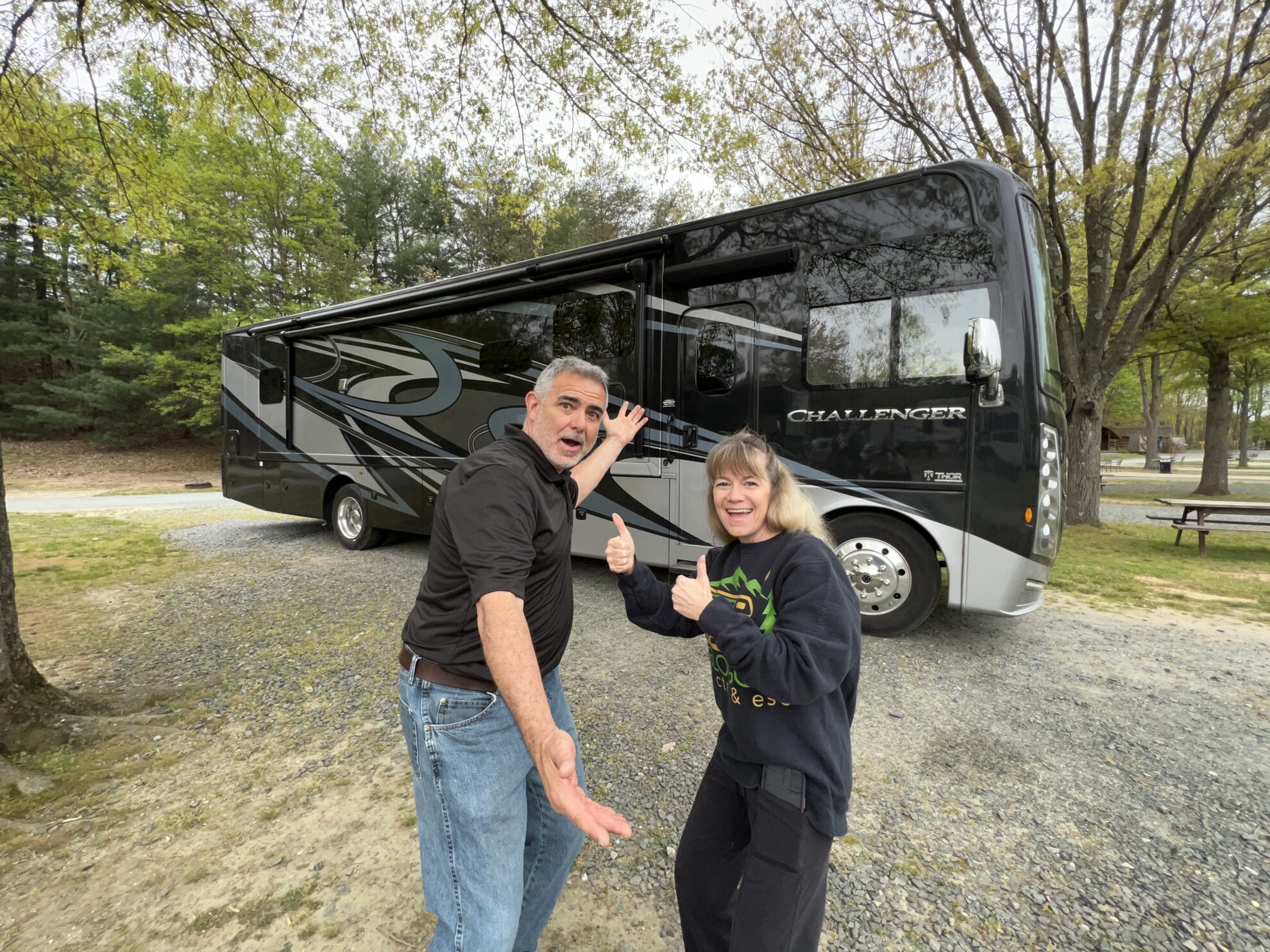
Mike has decades of camping experience and has traveled extensively in both a Gulf Stream Conquest Class C and a Thor Challenger Class A motorhome. He and Susan spend much of the year on the road, attend RV shows, visit dealerships, and tour RVs across the country.
Through RVBlogger.com and the RVBlogger YouTube channel, Mike shares practical, first-hand advice about RV buying, floor plans, ownership, maintenance, gear, campgrounds, and the RV lifestyle.