
Thanks for your support! If you make a purchase using our links in this article, we may make a commission. And, as an Amazon Associate, I earn from qualifying purchases. See the full disclosure here.
Published June 8, 2020 | Last updated August 3, 2026
A compact countertop ice maker is one of those RV appliances that sounds unnecessary until you own one.
I owned a portable ice maker for years, and I loved it. It made a surprising amount of ice and kept up with our drinking throughout the day, so Susan and I could always have nice cold drinks without constantly buying bags of ice.
That convenience matters more in an RV than it does at home. Most RV refrigerators either do not have a built-in ice maker or have a freezer that is too small to produce and store much ice.
But not every countertop ice maker is a good fit for an RV. Some are too large, too heavy, difficult to clean, or designed for a kitchen counter where they never have to be moved.
For RV use, I would focus on compact size, fast bullet-ice production, easy draining, simple cleaning, and whether you have a safe place to store the machine while traveling.
Are Portable Ice Makers Worth It in an RV?
For us, the answer was yes.
Our ice maker produced ice quickly enough to stay ahead of the drinks we were making. We did not have to ration ice, wait for trays to freeze, or make repeated trips to the campground store.
A portable ice maker makes the most sense when you:
- Camp frequently in hot weather
- Drink a lot of water, iced tea, soda, or mixed drinks
- Have limited freezer space
- Host family or friends at the campsite
- Want to stop buying bags of ice
- Have enough counter and storage space for another appliance
The downside is that it is one more appliance to carry, clean, store, and plug in. If your RV has almost no countertop space or you only camp a few weekends a year, a couple of ice trays may be enough.
My Quick Recommendations
- Best overall for most RV owners: Euhomy Dart H1 Portable Bullet Ice Maker
- Best compact option: Silonn Countertop Bullet Ice Maker with Handle
- Best simple value option: Frigidaire EFIC125 Compact Ice Maker
- Best for heavier daily use: Euhomy Smart 2.2-Liter Countertop Ice Maker
- Best premium nugget ice maker: Euhomy Pearl L1 Max
Product models and Amazon listings change frequently. Before buying, verify the current dimensions, weight, voltage, warranty, and seller information on the exact listing.
1. Euhomy Portable Bullet Ice Maker
Best overall for most RV owners
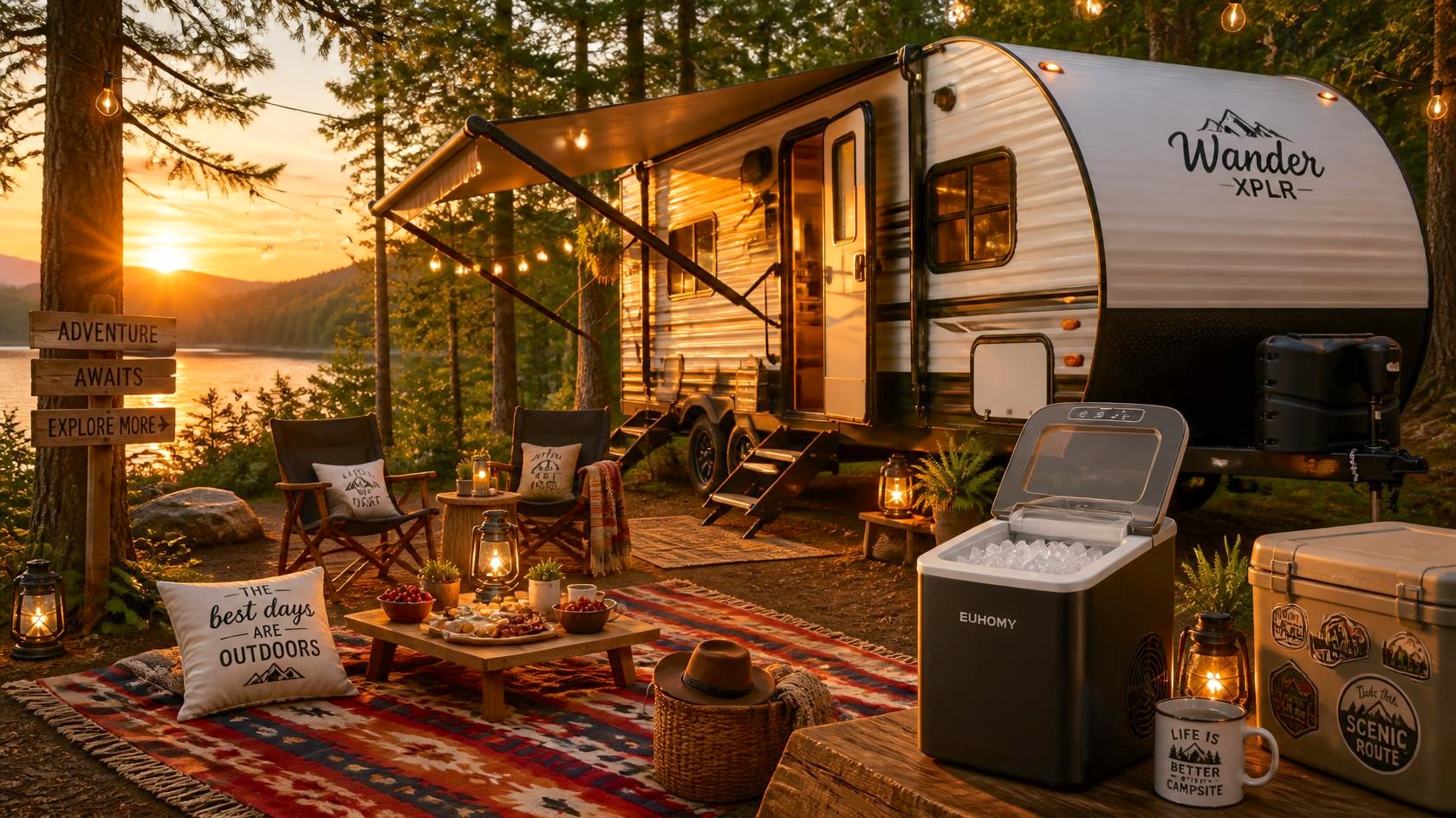
The Euhomy Ice Maker checks most of the boxes I would look for in an RV ice maker.
It is a compact bullet-ice machine with a carrying handle and an automatic cleaning cycle. The manufacturer rates it to produce nine bullet-shaped pieces in about six minutes and up to roughly 26 pounds over 24 hours under ideal conditions.
That does not mean you will open the lid at the end of the day and find 26 pounds of stored ice. The basket is much smaller than that. You have to keep adding water and removing the ice so the machine can continue cycling.
I like the carry-handle design for RV use because most people will not leave the machine permanently on the counter. It is easier to move into a cabinet, storage bay, or other secure location before driving.
- Best for: Couples and small families who want a practical everyday RV ice maker
- Main advantage: Compact size, handle, fast bullet ice, and automatic cleaning cycle
- What to consider: The basket does not keep finished ice frozen
2. Silonn Bullet Ice Maker with Handle
Best compact option
The compact handle-equipped ice maker is a good RV-style design because it is narrow, relatively easy to move, produces common bullet-shaped ice, and includes a self-cleaning cycle.
The manufacturer lists some versions at approximately 12.3 by 8.7 by 12.5 inches. That narrow footprint can be important in an RV kitchen where a few inches of counter width makes a big difference.
This is the type of ice maker I would consider when counter space matters more than having the largest water tank or basket.
- Best for: Small travel trailers, Class B RVs, and limited counter space
- Main advantage: Narrow footprint and easy portability
- What to consider: Silonn sells multiple similar models, so verify the dimensions of the exact one you buy
3. Frigidaire Compact Ice Maker
Best simple value option
The Frigidaire ice maker is a straightforward countertop ice maker without a lot of unnecessary features.
It is designed to produce two sizes of bullet-shaped ice, with the first batch forming in about six minutes under the right conditions. The manufacturer rates it for up to 26 pounds per day and says the basket holds roughly one to one-and-a-half pounds at a time.
It also has a drain plug, which matters more than people realize. A machine that is easy to drain is much less annoying to empty, clean, dry, and store between trips.
I would choose a simple model like this if I wanted dependable bullet ice and did not care about Wi-Fi, specialty ice, or extra controls.
- Best for: RV owners who want a basic machine from a familiar brand
- Main advantage: Simple operation, fast ice, and easy drainage
- What to consider: It does not offer the same portability features as some handle-equipped models
4. Euhomy Smart 2.2-Liter Countertop Ice Maker
Best for heavier daily use
The larger Euhomy smart countertop model uses a 2.2-liter water tank and is rated to produce about 26 pounds of bullet ice per day.
The larger reservoir means fewer refills, which may be worthwhile for a family, a group camping trip, or anyone who makes ice continuously throughout the day.
The tradeoff is size. A larger tank usually means a larger appliance, and that can be a problem in a small RV.
Before choosing this one, measure the counter and the cabinet or storage bay where you plan to keep it while traveling. Do not assume that a countertop appliance will fit under an RV cabinet with the lid fully open.
- Best for: Families, entertaining, and heavier ice use
- Main advantage: Larger water reservoir
- What to consider: Takes up more counter and storage space
5. Euhomy Max Nugget Ice Maker
Best premium nugget ice maker
If you love soft, chewable nugget ice, this is the premium option on the list.
Nugget ice is very different from the hollow bullet ice produced by most compact RV ice makers. It is softer, denser, and better for people who like restaurant-style chewable ice.
The Max Nugget ice maker weighs roughly 19 pounds according to the manufacturer. That is not outrageous for a home countertop machine, but it is substantial when you have to move and secure it inside an RV.
Nugget machines are also usually more expensive and require more diligent cleaning because of the internal ice-making system.
I would only choose this style if nugget ice is genuinely important to you. For simply keeping drinks cold, a compact bullet-ice machine is easier and less expensive.
- Best for: RV owners who specifically want soft, chewable nugget ice
- Main advantage: Better ice texture
- What to consider: Higher price, more weight, more cleaning, and more storage space
What I Would Look for in an RV Ice Maker
The biggest production number on the box is not necessarily the most important specification.
These are the features that matter most in an RV:
Compact Dimensions
Measure the actual counter before ordering. Include the space required to open the lid and remove the basket.
Also measure the storage location. The ice maker needs to be secured before the RV moves. It should never sit loose on the counter while you are driving.
A Carrying Handle
A handle is not essential, but it makes the machine much easier to move between the counter, cabinet, picnic table, and storage compartment.
Easy Drainage
Look at the drain location. Some drain plugs are awkwardly placed and make it difficult to empty the last bit of water without tipping the entire appliance.
Self-Cleaning Cycle
A self-cleaning cycle is useful, but the name can be misleading.
It usually circulates water or cleaning solution through the machine. You still need to drain it, wipe the reservoir and basket, clean hard-to-reach surfaces, and let the machine dry.
Bullet Ice vs Nugget Ice
Bullet-ice machines are usually smaller, less expensive, and fast. Nugget-ice machines produce better chewing ice but generally cost more and require more maintenance.
Noise
Even a quiet ice maker makes compressor noise, fan noise, pump noise, and the sound of finished ice dropping into the basket.
That may not matter during the day. It can become annoying at night in a small RV where the kitchen is only a few feet from the bed.
Do Portable Ice Makers Need a Water Line?
No. Most compact countertop ice makers do not need a water line.
You pour drinking water into the reservoir, plug the machine into a standard 120-volt outlet, and start the ice-making cycle.
That is one reason they work well in an RV. There is no plumbing installation and nothing extra to winterize.
Do Portable Ice Makers Keep Ice Frozen?
No. Most portable ice makers are not freezers.
They make ice and drop it into an insulated basket. As the ice melts, the water usually drains back into the reservoir and is reused to make more ice.
This is convenient when you are making drinks throughout the day, but it also means you need to move finished ice into the RV freezer if you want to store it.
Fresh bullet ice is often wet and soft. If you dump a large batch directly into a freezer container, the pieces may freeze together. Spreading the ice out briefly before long-term storage can reduce clumping.
What Water Should You Use?
Use clean, potable water that you would be comfortable drinking.
Water quality affects the taste of the ice and how quickly mineral scale forms inside the machine.
Follow the manufacturer’s instructions for filtered, distilled, or reverse-osmosis water. Do not add salt or other substances to the reservoir unless the manual for your exact machine specifically tells you to do so.
How to Keep an RV Ice Maker Clean
An ice maker stays wet inside, which means it can develop mineral buildup, slime, odors, and mold if it is neglected.
My basic cleaning routine would be:
- Unplug the machine.
- Drain all remaining water.
- Remove and wash the ice basket and scoop.
- Clean the reservoir and interior with the solution recommended by the manufacturer.
- Run the self-cleaning cycle when equipped.
- Rinse thoroughly with fresh water.
- Drain again and leave the lid open until the interior is completely dry.
Do not leave old water sitting in the reservoir between camping trips.
Can You Run an Ice Maker on a Generator or Inverter?
Many compact ice makers can operate from an appropriately sized generator or inverter, but check the electrical label on the exact machine.
The compressor has a startup demand that may be higher than the normal running wattage. Your inverter also needs enough capacity, and your battery bank has to supply the energy for however long the machine runs.
When plugged into 30-amp campground service, remember that the ice maker shares power with the A/C, microwave, water heater, converter, and every other appliance. It is not usually a huge load, but it is another load.
How to Store an Ice Maker While Traveling
Do not leave the ice maker loose on the countertop while driving.
Drain and dry it before travel, then place it in a cabinet, storage bay, or secured container where it cannot slide, tip, or become a projectile during a sudden stop.
If the machine has been laid on its side, follow the manufacturer’s instructions before plugging it back in. Compressor appliances may need to sit upright before restarting.
My Bottom Line
I owned a portable ice maker for years, and it was one of those simple appliances that made RV life more enjoyable.
It made plenty of ice, stayed ahead of our drinks, and meant we could always have something cold without taking up the entire freezer with ice trays.
For most RV owners, I would choose a compact bullet-ice machine with a carrying handle, an easy-to-reach drain, and a self-cleaning cycle.
I would only spend more for a large-capacity or nugget-ice model if I knew I had the counter space, storage space, and a real reason to carry the extra size and weight.
Related Reading:
- How Often Should I Change My RV Water Filter?
- Best Places to Buy RV Accessories and Supplies
- Best Ways to Reduce RV Weight
Mike Scarpignato – Bio
Mike Scarpignato founded RVBlogger.com with his wife, Susan, in 2018 to help new and experienced RVers make better decisions about buying, owning, and traveling in an RV.
Mike has decades of camping experience and has traveled extensively in both a Gulf Stream Conquest Class C and a Thor Challenger Class A motorhome. He and Susan spend much of the year on the road, attend RV shows, visit dealerships, and tour RVs across the country.
Through RVBlogger.com and the RVBlogger YouTube channel, Mike shares practical, first-hand advice about RV buying, floor plans, ownership, maintenance, gear, campgrounds, and the RV lifestyle.