
Thanks for your support! If you make a purchase using our links in this article, we may make a commission. And, as an Amazon Associate, I earn from qualifying purchases. See the full disclosure here.
Published January 18, 2021 | Last updated July 31, 2026
Can you dump your RV tanks at home? In many cases, you can empty your black and gray tanks into an approved residential sanitary sewer cleanout. But you need to verify that local rules allow it and make absolutely sure you are connecting to the sanitary sewer—not a storm drain.
Susan and I have dumped our RV tanks at our Maryland home when we returned from boondocking or stayed at a campground without a dump station.
We last did it about a year ago.
Our house is connected to a public sanitary sewer, and we have a cleanout in the front yard. That lets us connect the RV sewer hose and send the wastewater into the same sewage system that handles our toilets, sinks, and showers.
It is convenient because I can take my time, use the tools I keep at home, and give the tanks a more thorough rinse than I would when five RVs are waiting behind me at a campground dump station.
But dumping at home is not as simple as opening a valve wherever you happen to be parked.
You need the correct connection, permission from your local sewer authority when required, a secure sewer hose, and a plan for avoiding spills and overfilling.
This article covers both black and gray tanks, the exact method we use, and the mistakes I would never make.
Watch Us Empty Our RV Black Tank at Home
In this video, I show the sanitary sewer cleanout at our house, how we connect the sewer hose, and how we use a RhinoBlaster to flush the black tank.
The video was filmed with our Class C, but the basic process is the same for a travel trailer, fifth wheel, Class A, or another RV with standard black and gray holding tanks.
I have updated the instructions below with stronger safety guidance and a clearer explanation of public sewer versus private septic systems.
Is It Legal to Dump RV Tanks at Home?
It depends on where you live and where the wastewater is going.
Some cities, counties, utilities, and homeowners associations allow an RV owner to use a residential sanitary sewer cleanout. Others restrict it or require permission.
Before dumping, contact your local wastewater or public-works department and ask:
- May a homeowner discharge RV black and gray water into a residential sanitary sewer cleanout?
- Are permits, fees, or volume restrictions involved?
- Are RV holding-tank chemicals restricted?
- Is my cleanout connected to the sanitary sewer or another drainage system?
Do not assume that because the pipe is on your property, you can legally put RV waste into it.
The EPA explains that sanitary sewers carry household wastewater to a treatment facility, while separate storm-sewer systems generally carry rainwater directly to local waterways without sewage treatment. You can review that distinction in the EPA’s sewer-system overview.
Never dump RV black or gray water into a storm drain, gutter, street, ditch, yard, or body of water.
That is the Cousin Eddie method from Christmas Vacation, and it can contaminate waterways, create a public-health problem, anger every neighbor on the block, and lead to serious fines.
If you cannot positively identify an approved sanitary connection, use a legal RV dump station instead.
Sanitary Sewer Cleanout vs. Storm Drain
A sanitary sewer cleanout is usually a capped pipe that provides access to the home’s wastewater line.
It may be located:
- Near the house foundation
- In a front or side yard
- Near the driveway
- In a basement or utility area
- Close to where the home’s main drain exits the building
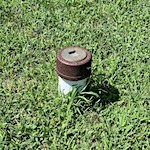
A storm drain is normally found along a street, curb, driveway, parking lot, or low area where rainwater collects.
Most storm drains are not connected to a wastewater treatment plant. The water may flow into a stream, river, lake, bay, or retention pond.
Do not rely on what a pipe or drain “looks like.” Have the connection verified by your local utility, plumber, septic professional, or property documentation.
Can You Dump an RV Into a Home Septic System?
Possibly, but I would be more cautious with a private septic system than with an approved municipal sanitary sewer connection.
We use a public sewer cleanout at our home. I am not claiming personal experience dumping our RV into a private septic system.
A septic system treats wastewater on the property. A sudden full black-and-gray-tank dump can add a large volume of liquid and solids at once.
The EPA warns that excessive water can overload a septic tank and drainfield. It also warns that some holding-tank chemicals can damage the biological activity the system depends on.
Before dumping into a septic system:
- Check local health-department and permitting rules
- Ask a licensed septic professional whether the system can handle the volume
- Make sure you know which access point is approved
- Confirm the system is functioning properly and is not overdue for pumping
- Do not park or drive the RV over the septic tank or drainfield
- Dump slowly rather than releasing a huge surge
- Avoid products containing chemicals that can harm septic-system bacteria
The EPA’s RV wastewater disposal guidance warns that some deodorizer chemicals may pollute water resources or interfere with onsite treatment systems.
Its septic-system care guide also explains why water volume, solids, and chemicals matter.
If you are unsure, do not use the septic system. A public RV dump station is cheaper than repairing a failed drainfield.
Why Would You Dump RV Tanks at Home?
Convenience is the main reason.
We may return from:
- A boondocking trip
- A campground without a dump station
- A site with electric and water but no sewer hookup
- A busy campground where the dump-station line is backed up
Dumping at home also gives me more time to clean and maintain the tanks.
At a campground, I do not want to hold up the line by repeatedly filling and flushing a black tank.
At home, I can work carefully, keep an eye on the tank, rinse the hose thoroughly, and put treatment back in when I am finished.
There are times when dumping at home is not worth it.
Use a regular dump station when:
- Local rules do not clearly allow home dumping
- You cannot verify the cleanout
- The RV cannot be positioned safely
- The sewer hose will not reach without leaking or running uphill
- Your septic professional advises against it
- You have nowhere sanitary to rinse and store the equipment
What You Need to Dump RV Tanks at Home
Do not improvise with household equipment.
I recommend:
- A quality RV sewer hose
- A clear elbow or clear sewer fitting
- A threaded sewer adapter when the cleanout accepts one
- Heavy-duty disposable nitrile gloves
- A dedicated non-potable rinse hose
- Wheel chocks
- Paper towels and hand sanitizer
- A RhinoBlaster or built-in tank rinse for deeper flushing
- Weights or another safe way to keep an unthreaded connection from moving
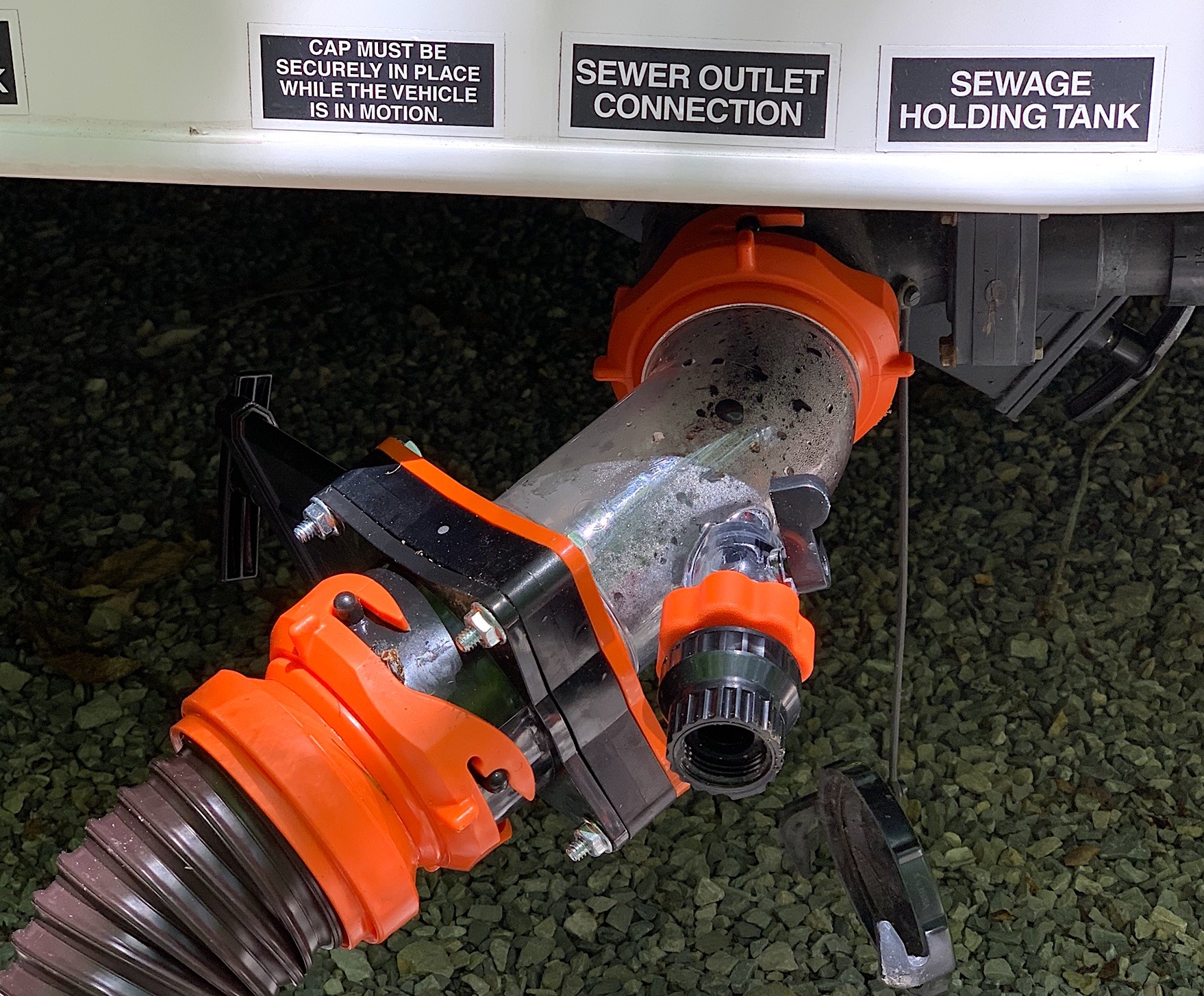
We use the RhinoFLEX 15-Foot Complete RV Sewer Hose Kit.
The clear fitting lets me see when the tank has finished draining and when the rinse water is running clear.
I also use GLOVEWORKS nitrile gloves. They are thicker than many disposable gloves, and the raised diamond texture gives me a much better grip on slippery sewer fittings.
Keep every piece of sewer equipment separate from your drinking-water equipment.
Our potable hoses and sewer-rinse hose are different colors. I would never connect our freshwater hose to a sewer fitting, RhinoBlaster, black-tank rinse, or questionable outdoor faucet.
1. Confirm the Cleanout and Local Rules
Do this before positioning the RV or opening any tank valve.
Verify that the pipe is connected to the sanitary sewer or approved septic connection.
Remove the cleanout cap slowly.
If sewage is already standing in the pipe or immediately begins backing up, stop. You may have a blockage or another plumbing problem that needs attention.
Do not force a damaged, rusted, or stuck cleanout cap. A plumber can help without breaking the pipe.
2. Position and Secure the RV
Park close enough that the sewer hose reaches the cleanout without stretching, kinking, or running uphill.
Our sewer outlet and cleanout are on opposite sides of the driveway, so I run the hose beneath the RV.
Any time I need to reach beneath the motorhome, I use wheel chocks and make sure the RV cannot move.
Never crawl under an RV supported only by leveling jacks.
Make sure the sewer-hose route will not be driven over, stepped on, pinched by a slide, or damaged by a sharp edge.
3. Connect the Sewer Hose Securely
Put on your gloves.
Confirm that both the black and gray valves are fully closed before removing the RV sewer cap.
Connect the sewer hose to the RV outlet.
Place the other end into the approved cleanout using the proper adapter.
A threaded connection is best because it reduces the chance of the hose jumping out.
If the connection is not threaded, it still needs to be snug and stable. In our setup, I place weights over the hose connection so it cannot move when the tank begins draining.
Do not jam the hose so far into the pipe that it blocks airflow or becomes stuck.
Stay close enough to stop the flow immediately if something leaks, backs up, or shifts.
4. Dump the Black Tank First
Once both ends of the sewer hose are secure, open the black-tank valve.
The black tank contains toilet waste, so dump it before the gray tank.
Let it drain completely.
Watch the clear fitting and the cleanout connection while it drains.
If the cleanout begins backing up, close the black valve immediately.
Do not open the gray valve at the same time. You want to keep that gray water available to rinse the sewer hose after the black tank has emptied.
5. Dump the Gray Tank Second
Close the black-tank valve after it has finished draining.
Then open the gray-tank valve.
Gray water is not clean water. It may contain food particles, grease, soap, hair, and bacteria.
But dumping it second helps wash some of the black-tank residue from the sewer hose.
Let the gray tank drain, then close the valve.
6. Flush the Black Tank Without Overfilling It
If your RV has a built-in black-tank rinse, you may not need a RhinoBlaster for routine black-tank cleaning.
Built-in systems spray water inside the black tank, but they usually rinse only the black tank—not the gray tank.
Our older Class C did not have a built-in rinse, so we used a RhinoBlaster with a gate valve.
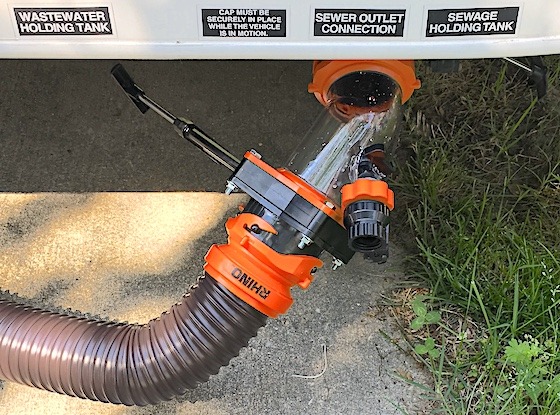
I specifically recommend the model with the gate valve.
The additional gate allows water to be held temporarily so it can backflush the outlet plumbing and help rinse the tank.
The basic process with our setup is:
- Keep the sewer hose securely connected to the approved cleanout.
- Connect a dedicated non-potable rinse hose to the RhinoBlaster.
- Open the RV black-tank valve.
- Close the RhinoBlaster gate valve.
- Turn on the rinse water and closely monitor the tank.
- Turn the water off well before the tank can overfill.
- Open the RhinoBlaster gate and allow the rinse water to drain.
- Repeat only as needed.
Never walk away while water is entering a holding tank.
Do not trust the tank sensor completely. RV sensors often give false readings because waste sticks to them.
Have someone monitor the control panel and the toilet, and keep the water volume conservative.
Overfilling a black tank can force sewage into the vent, toilet, plumbing, or RV interior.
You do not need to fill the tank completely to get useful flushing action.
Follow the instructions for your exact RV, built-in rinse, and flushing attachment. Different plumbing layouts may require a different procedure.
7. Rinse, Disconnect, and Sanitize
After the black and gray tanks have drained:
- Confirm both RV tank valves are closed.
- Turn off and disconnect the rinse water.
- Drain any remaining liquid from the sewer hose into the cleanout.
- Disconnect the hose from the RV carefully.
- Rinse the sewer equipment with the dedicated non-potable hose.
- Remove the hose from the cleanout.
- Replace the cleanout cap securely.
- Install the cap on the RV sewer outlet.
- Store the sewer hose and fittings in their dedicated container.
- Remove the gloves properly and sanitize your hands.
Before putting the RV away, check one more time that both the black and gray valves are fully closed.
Use the Right Tank Treatment After Dumping
Once the tanks are empty, I do not leave the black tank bone dry.
Add enough clean water to cover the bottom and use the tank treatment according to the label.
We use the Liquified RV line:
- Liquified RV Tank Treatment for routine black-tank use
- Liquified Tank and Sensor Cleaner when the tank or sensors need deeper cleaning
- Liquified Gray Tank Treatment for gray-tank odors and buildup
A treatment does not replace water, proper dumping, or occasional flushing.
One of the worst things you can do is use too little water in the black tank. Waste and toilet paper need liquid to break down and flow out.
If you have a private septic system, read every treatment label and confirm compatibility with your septic professional. Avoid formaldehyde and other chemicals that can interfere with the organisms that treat wastewater.
Should You Use a Macerator Pump at Home?
A macerator pump can be useful when the approved sewer connection is too far away or slightly uphill.
It grinds the waste and pumps it through a smaller dedicated discharge hose.
A macerator does not make it legal to send sewage somewhere it does not belong.
The discharge still needs to enter an approved sanitary sewer or septic connection, and the hose must be reserved only for sewage.
Follow the pump manufacturer’s distance, elevation, electrical, and duty-cycle limits.
I would choose a macerator over carrying raw sewage through the house in buckets.
Methods I Do Not Recommend
I do not recommend emptying a black tank into buckets and carrying them through the house to a toilet.
It creates too many opportunities for spills, exposure, splashing, and contamination.
I also would not connect a septic pump truck directly to an RV holding tank unless the RV manufacturer and qualified service provider have an approved method for controlling suction.
RV holding tanks are thin plastic containers. They are not designed for uncontrolled vacuum pressure.
Use an RV dump station, sanitary sewer connection, approved septic connection, or properly operated macerator instead.
What Should You Do if Black Water Spills?
Close the tank valve or stop the pump immediately.
Keep children and pets away from the area.
Wear protective gloves and avoid direct contact.
For a small spill on a hard, nonporous surface:
- Contain the liquid with disposable absorbent material
- Collect the contaminated material in a secure waste bag
- Clean and disinfect the surface with an appropriate product
- Prevent rinse water from entering a storm drain or waterway
- Wash your hands thoroughly
For a large spill, a spill that reaches soil or a storm drain, or a spill you cannot safely contain, contact your local health department, wastewater authority, or environmental agency for instructions.
Do not dump bleach, lime, or other chemicals onto the ground without direction from the responsible local authority. Adding more chemicals can create another environmental problem.
Common Mistakes When Dumping RV Tanks at Home
- Assuming every outdoor drain is connected to the sanitary sewer
- Failing to check local rules first
- Dumping into a storm drain or onto the ground
- Using a drinking-water hose for sewer cleanup
- Opening a valve before both hose connections are secure
- Dumping gray water before black water
- Walking away while flushing a tank
- Trusting inaccurate tank sensors
- Overloading a private septic system
- Using tank chemicals that can harm septic-system bacteria
- Parking or driving over a drainfield
- Forgetting to close the valves before removing the RV sewer cap
Our At-Home RV Tank Dumping Checklist
- Verify that local rules allow the discharge.
- Confirm the connection is an approved sanitary sewer or septic cleanout.
- Position the RV and install the wheel chocks.
- Put on gloves and connect the sewer hose securely.
- Open the black valve and let the black tank drain.
- Close the black valve.
- Open the gray valve and let the gray tank drain.
- Close the gray valve.
- Flush the tank only when the equipment and local rules allow it.
- Never leave a filling tank unattended.
- Confirm both tank valves are closed.
- Drain, disconnect, rinse, and cap the equipment.
- Replace the sanitary cleanout cap.
- Store the sewer equipment separately.
- Sanitize your hands.
- Add water and the appropriate tank treatment.
Final Thoughts
Dumping our RV tanks at home has been convenient when we returned from boondocking or a campground without a dump station.
It also gave me the time and space to flush the tanks more thoroughly.
But the most important part is not the RhinoBlaster, the sewer hose, or how clear the rinse water looks.
It is making sure the waste enters an approved sanitary system.
Verify the local rules. Identify the cleanout correctly. Secure the hose. Dump black first and gray second. Monitor every rinse. Keep the freshwater and sewer equipment completely separate.
And when there is any doubt, use a legal RV dump station.
Convenience is not worth damaging your plumbing, contaminating a waterway, or creating the kind of neighborhood story people will still be telling ten years from now.
Related Reading
How to Flush and Clean RV Holding Tanks
How to Clean and Store an RV Sewer Hose
What Are RV Holding Tanks and How Do They Work?
Should You Keep Your RV Gray Tank Open or Closed?
Mike Scarpignato – Bio
Mike Scarpignato founded RVBlogger.com with his wife, Susan, in 2018 to help new and experienced RVers make better decisions about buying, owning, and traveling in an RV.
Mike has decades of camping experience and has traveled extensively in both a Gulf Stream Conquest Class C and a Thor Challenger Class A motorhome. He and Susan spend much of the year on the road, attend RV shows, visit dealerships, and tour RVs across the country.
Through RVBlogger.com and the RVBlogger YouTube channel, Mike shares practical, first-hand advice about RV buying, floor plans, ownership, maintenance, gear, campgrounds, and the RV lifestyle.

Good point Mike
I have been dumping my RV Tanks into my sept system for over 50 years,
But I also take care of my system within my RV.
1. No Mather which way I am coming home from a Snow Bird trip or one to see other states I check all roads ways coming home as to where there is a rest area and does it have a dump station.
You ask, If I dump at home why do I care? I look at it this way,
1. I can dump at a rest area after pulling some 100 miles or more in which the Black/Gray tanks have ben mixed up. (than I dump tanks) I add cleaning material in each tank and than fill each tank to around 1/3 full. Complete the trip to the house OR you can take it to the next Highway dump station and dump each tank. I know you are on your way home but take a little time for this and you will have lest problems and your tanks leaver readings will be reading true. You will also get all the heavy stuff out of your tanks. Just in case you have hose break lose at your home, you will be 80 clean and it is a good chance that your friends will not note a problem. Also, you might come in at night, so there will not be that rush to dump thanks.
It is a terrible idea to dump 150+ gallons of RV waste into your septic system, doing so creates turbulence in your septic tank and causes solids to be pushed out to the drain field causing premature failure.
You are RIGHT, but you should not dump Stright into your tank. inside your tank is another world and also stop’s those good little things that break down the material be for it goes to the drain field.
I run it some 50/60 feet and into a trap to slow down the speed. That lets those things have their chance before they send it off to their friends in the drain field.
Can u use the grey water to water plants?
I would NOT” Because it is called GREY water does not mean it is free of bad things.
Gray water is things like all kinds of SOAP and cleaners to remove grease. and other types of cleaning products. What about the stuff women use to Dall themself up =Men too. this never gets into the Black water tank. In my rig the only other water that goes into the Black water is from the water sink in the bathroom.
Are you able to just drain it on the ground without using a septic hose?
First – wither it is Black or Gray water in most cases it would no be good to do this.
The other thing is they make equipment to pump out your tanks without using a septic hose..
They make a grander/pump just for pumping some 200/250 feet to a your system. the hose is 3/4″, this slows down the speed and make sure there is no lumps going into your sept system. so in respects it helping you sept system take care of the waste faster. And for the things that breakdown in help them by should we say its not a bake patio it comes to them mash.
How can I find out if dumping is legal where I live? I can’t find info on it anywhere. I’m in Southern California.
Hi Marisa,
Your county government website would be a good place to look. It might be under Department of Sanitation or Water and Sewer. You can also call your county government and ask to speak with someone in that department or ask if they can tell you where their guidelines are located on their website.
Hope that helps!
Mike