
Thanks for your support! If you make a purchase using our links in this article, we may make a commission. And, as an Amazon Associate, I earn from qualifying purchases. See the full disclosure here.
You can find an RV with the perfect floor plan, plenty of storage, a big refrigerator, a king bed, and every feature you want—and still buy the wrong RV.
Why?
Because you may not be able to put very much stuff in it.
This is one of those RV-buying issues that sounds technical until you understand what it really means.
Cargo carrying capacity is simply how much weight you can add to the RV before it becomes too heavy.
That added weight can include people, clothes, food, camping chairs, tools, grills, bikes, water, extra batteries, a generator, and all the other stuff you plan to bring camping.
On a travel trailer or fifth wheel, the cargo carrying capacity usually refers to what you can load into the trailer itself.
On a motorhome, you will often see the term OCCC, which stands for Occupant and Cargo Carrying Capacity. That number has to cover the people riding in the motorhome plus the stuff you bring with you.
The letters are not the important part.
The important question is:
After I put real people and real camping gear in this RV, will I still be under its weight limits?
I wish more RV buyers asked that question before they started negotiating the price.
Start With the Yellow Weight Sticker, Not the Brochure
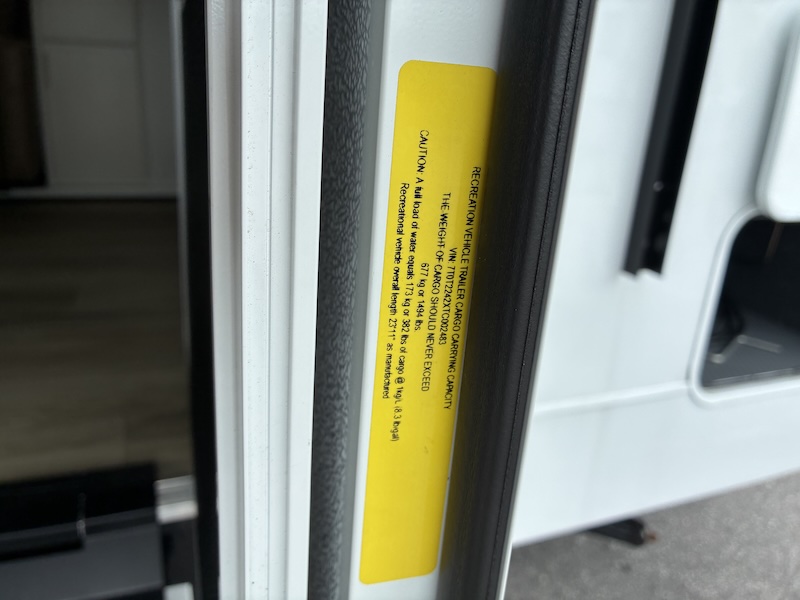
Before buying an RV, find the cargo carrying capacity label on the exact RV you are considering.
Do not rely only on a brochure.
Do not rely only on a dealer website.
And do not assume two RVs with the same model number have exactly the same cargo capacity.
Factory options and equipment can change how much the RV weighs before you put anything in it.
The National Highway Traffic Safety Administration requires RV cargo-capacity information to reflect the RV as configured for delivery, and it specifically advises buyers to determine before purchase whether an RV has enough capacity for things such as water, additional equipment, and luggage. You can read the NHTSA guidance here.
For a trailer, the sticker may say something similar to:
The weight of cargo should never exceed 1,450 pounds.
That means you have about 1,450 pounds available for the stuff you add.
For a motorhome, the label may say:
The combined weight of occupants and cargo should never exceed 1,800 pounds.
That means the people riding in the motorhome count too.
That is really all you need to understand before we get into the other numbers.
Here Is Cargo Carrying Capacity in Plain English
Think of your RV like an elevator with a weight limit.
The elevator itself already weighs something.
The manufacturer tells you how much additional weight you can put inside before reaching the safe limit.
Your RV works the same way.
Imagine a travel trailer that can carry 1,500 pounds.
You load:
- Camping chairs: 50 pounds
- Tools and RV gear: 150 pounds
- Food and kitchen supplies: 150 pounds
- Clothes and personal items: 150 pounds
- Grill and outdoor gear: 100 pounds
- Bikes: 100 pounds
You have already added 700 pounds.
That leaves about 800 pounds.
That may be plenty.
But if the same trailer only had 800 pounds of cargo carrying capacity, you would be nearly maxed out before adding much else.
The RV did not change.
Your camping experience did.
Low Cargo Capacity Can Change How You Camp
This is why I think cargo carrying capacity belongs in the buying decision—not in a math lesson six months after you buy the RV.
A low-capacity RV may force you to:
- Leave camping gear at home
- Carry less food
- Travel with little or no fresh water
- Skip heavier upgrades
- Avoid adding extra batteries or solar equipment
- Carry bikes somewhere else
- Move gear from the RV into the tow vehicle
- Constantly worry about weight
That may be fine for someone who camps two weekends a year at full-hookup campgrounds.
It may be completely unacceptable for someone who travels for weeks at a time, boondocks, carries tools, brings grandchildren, or wants a lot of outdoor gear.
The right number depends on how you plan to use the RV.
That is why I would never tell someone there is one minimum cargo capacity that works for everybody.
I would build a rough weight budget before buying.
Our Jeep Choice Was Really a Weight-Capacity Decision
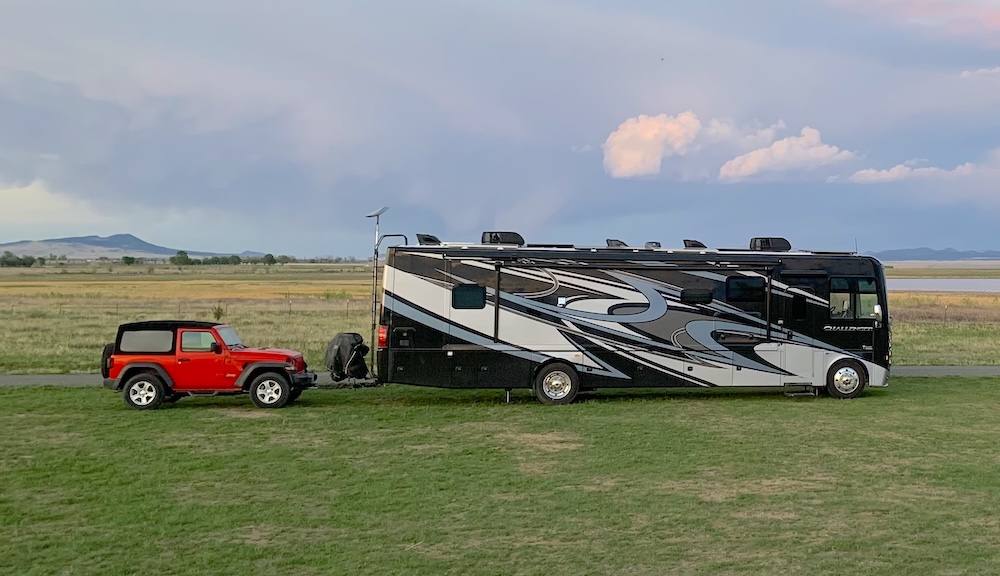
When Susan and I bought our 2021 Thor Challenger 37FH Class A motorhome, we also had to decide what vehicle we were going to tow behind it.
We wanted a Jeep Wrangler.
The question was whether to buy the two-door or four-door version.
I liked the flexibility of the four-door Jeep, but it weighs more.
That mattered to me.
The motorhome has one weight limit for the coach itself and another limit for the motorhome and everything it is towing combined.
In plain English:
The heavier the Jeep behind us, the less overall weight cushion I had left.
We chose the two-door Wrangler partly because it was lighter.
I also wanted extra margin rather than trying to load everything right up to the maximum number.
There is an important technical distinction here.
The Jeep did not actually change the cargo carrying capacity printed on our motorhome’s yellow sticker.
Instead, the Jeep used some of our motorhome’s combined-weight capacity—the total weight allowed for the loaded motorhome plus the vehicle being towed.
But from a buyer’s point of view, I was trying to solve the same problem:
How much weight room will I have left once we are actually traveling?
Our Class A and Jeep Example Without the Confusing Math
Here is an easy example using rounded numbers similar to the decision we were making.
Suppose a motorhome is allowed to weigh up to 30,000 pounds when you count the loaded motorhome and the Jeep together.
If the loaded motorhome weighs 24,000 pounds, you have 6,000 pounds left before reaching that combined limit.
Now compare two Jeeps:
- A lighter two-door Wrangler weighing roughly 4,000 pounds
- A heavier four-door Wrangler weighing roughly 4,400 pounds, depending on trim and equipment
With the two-door Jeep:
30,000 – 24,000 – 4,000 = about 2,000 pounds of combined-weight margin.
With the heavier four-door Jeep:
30,000 – 24,000 – 4,400 = about 1,600 pounds of margin.
Neither example says you can put another 2,000 or 1,600 pounds inside the motorhome. The motorhome still has to stay under its own weight rating and axle ratings.
It simply shows why I preferred the lighter Jeep.
It gave me a few hundred more pounds of breathing room in the overall combination.
Actual Wrangler weight varies by engine, trim, doors, and options, so I would use the actual weight of the Jeep you are considering—not an internet average.
Thor also explains this basic towing relationship in its motorhome guidance: available towing capacity depends on the difference between the RV’s actual loaded weight and its gross combined weight rating.
Motorhome Buyers Need to Count People Too
This is where motorhome buyers can get surprised.
A travel trailer’s cargo number is mostly about the things you load into the trailer.
A motorhome’s occupant-and-cargo number also has to cover the people riding inside.
Suppose you find a beautiful motorhome with 1,200 pounds of occupant and cargo capacity.
Two adults weigh a combined 350 pounds.
You now have about 850 pounds left.
Add clothes, food, tools, chairs, hoses, electrical cords, a grill, and personal items, and that 850 pounds can disappear much faster than you expect.
Add two more passengers and it disappears even faster.
That is why the number of seatbelts or beds in a motorhome does not automatically mean you can fill every seat and every storage compartment at the same time.
The Tiffin Wayfarer Example Really Opened My Eyes
I have walked through Tiffin Wayfarer Class C motorhomes with surprisingly low occupant and cargo carrying capacity.
On some individual units and configurations, I have seen numbers around 750 pounds.
Think about what that means.
If two people together weigh 350 pounds, you are down to roughly 400 pounds for everything else you carry in the motorhome.
Clothes.
Food.
Tools.
Camp chairs.
Hoses.
Electrical cords.
Personal items.
Anything you add after delivery.
It is not much.
I called Tiffin about this because I thought the number was so low.
I was told that the Mercedes chassis was overengineered and capable of handling more than the numbers suggested.
I was also told that most people camp close to home and do not boondock, so carrying a lot of fresh water was rarely an issue.
That was the explanation I was given.
But I would still make my buying decision based on the weight rating printed on the RV—not on the idea that the chassis may be capable of more than the rating.
And I would not assume everyone camps close to home.
Susan and I certainly do not.
Before buying any motorhome with a low occupant-and-cargo number, I would add up the people and the stuff I realistically plan to carry.
Water Matters, but Usually Not as Much as People Think
Fresh water weighs about 8.3 pounds per gallon.
So a 50-gallon tank can hold about 415 pounds of water.
That sounds enormous.
But most RVers do not routinely drive around with a completely full freshwater tank.
If you normally camp with full hookups, you may travel with very little water and fill up after you arrive.
If you boondock, dry camp, stay overnight at Harvest Hosts, or regularly camp without water hookups, the amount of water you carry can become much more important.
I would not reject an RV just because it has a large freshwater tank.
I would simply include the amount of water I actually expect to carry in my weight budget.
Twenty gallons is about 166 pounds.
Fifty gallons is about 415 pounds.
You decide what matches your camping style.
Travel Trailer Buyers Have Two Weight Problems to Solve
With a travel trailer or fifth wheel, you need to think about the RV and the tow vehicle at the same time.
First question:
Can the trailer carry all of our camping stuff without exceeding its own weight limit?
Second question:
Can our truck carry the weight the trailer puts on the hitch, plus the people and gear in the truck?
This is where beginners sometimes get caught.
They find a trailer with a published dry weight that looks fine for their truck.
Then they load 1,000 pounds of gear into the trailer.
The trailer is still under its own weight limit, but the extra weight can increase the amount of weight pressing down on the truck’s hitch.
That hitch weight counts against the truck’s payload capacity.
So you can have a trailer that is legal by itself and a truck that is overloaded when the two are connected.
Our article RV Weight Explained goes deeper into the different weight ratings, but you do not need to memorize every abbreviation to shop intelligently.
Just remember:
The trailer has a weight limit, and the truck has a weight limit. You have to satisfy both.
A Simple Travel Trailer Example
Suppose a travel trailer has 1,500 pounds of cargo carrying capacity.
You add 1,000 pounds of camping gear.
The trailer itself may still be fine because you have about 500 pounds remaining.
But some of that added trailer weight will also increase the tongue weight pressing down on your truck.
Now imagine your truck only had 1,400 pounds of payload available.
Put 900 pounds of loaded tongue weight on the hitch and you have 500 pounds left for:
- The driver
- Passengers
- Anything in the truck bed
- Coolers
- Firewood
- Bikes
- The weight-distribution hitch
A family can use up that 500 pounds very quickly.
This is why I would never shop for a travel trailer using tow rating alone.
Payload and real loaded weights matter too.
Fifth Wheels Can Use Truck Payload Even Faster
The same issue applies to fifth wheels, but the amount of weight carried by the truck is usually much higher.
A fifth wheel places a significant portion of its loaded weight directly over the truck’s rear axle through the hitch.
That means a truck can have enough advertised towing capacity for the fifth wheel but not enough payload capacity for:
- The loaded pin weight
- The fifth-wheel hitch
- Passengers
- Tools
- Anything else in the truck
This is especially important when someone sees “half-ton towable” in an RV advertisement.
That phrase does not mean every half-ton truck can safely carry that fifth wheel.
Check the actual payload sticker on your truck.
You can also see examples in our Best Half-Ton Fifth Wheels article.
Storage Space Can Fool You
This one bothers me because RV manufacturers are very good at creating storage.
You open the pass-through compartment and think:
Wow, I can put everything in here.
Maybe you can fit everything.
That does not mean you can carry everything.
A huge basement compartment on a motorhome with low cargo capacity is not nearly as useful as it looks.
The same applies to giant front storage compartments on travel trailers and fifth wheels.
Volume and weight are different things.
You may have room for:
- A Blackstone griddle
- Toolboxes
- Extra batteries
- A generator
- Firewood
- E-bikes
- Camping chairs
- Outdoor rugs
- Water hoses
- Electrical equipment
But the weight adds up whether or not the compartment still looks half empty.
Dealer-Installed Upgrades Can Eat Into Your Margin
Before you buy, think about the heavier equipment you may add later.
Examples include:
- Lithium batteries
- Additional lead-acid batteries
- Solar panels
- A generator
- Washer and dryer
- Additional furniture
- Bike racks and bikes
- Storage trays
- Large toolboxes
- Aftermarket suspension equipment
Some upgrades weigh very little.
Others can take a big bite out of a low cargo number.
If I know I want to add 300 pounds of equipment after buying the RV, I want that 300 pounds in my calculation before I sign the contract.
How Much Cargo Carrying Capacity Do You Need?
I do not think there is one perfect number.
A retired couple who travels light and stays mostly at full-hookup campgrounds may need much less than a family of five carrying bikes, food, toys, tools, and outdoor equipment.
Instead of looking for a magic CCC number, do this:
Step 1: Add the people.
For a motorhome, add the approximate weight of everyone who will normally ride in it.
Step 2: Estimate your normal camping gear.
Include clothes, food, outdoor furniture, tools, hoses, electrical gear, kitchen supplies, bikes, grills, and personal items.
Step 3: Add permanent upgrades.
Include batteries, solar equipment, washer/dryer, racks, and anything you know you will install.
Step 4: Add the water you normally carry.
Not the tank’s maximum unless you expect to travel full.
Step 5: Leave a cushion.
I do not like planning to use every last pound.
People underestimate gear. We buy more stuff. Tanks are not always empty. Scale weights change. I want room for error.
My Cargo Capacity Shopping Example
Suppose Susan and I are shopping for a motorhome.
We estimate:
- People: 350 pounds
- Clothes and personal items: 150 pounds
- Food and kitchen supplies: 150 pounds
- Tools and RV equipment: 200 pounds
- Camping chairs, grill, and outdoor gear: 150 pounds
- Miscellaneous stuff we forgot to count: 150 pounds
That is already 1,150 pounds.
If the motorhome has only 1,200 pounds of occupant-and-cargo capacity, I would not consider that enough for us.
Technically, the math might work on paper.
Real life would be too tight.
If the same motorhome had 2,000 pounds available, I would feel much better because I would have room for water, future equipment, extra supplies, and normal estimating mistakes.
That is how I would use CCC while shopping.
Not as trivia.
As a filter.
Ask the Dealer for the Weight Sticker Before You Drive There
This is a very easy buyer trick.
If you are shopping online or traveling several hours to see an RV, ask the salesperson to text or email you a clear photo of the cargo carrying capacity label on the exact RV.
Not another RV of the same model.
The exact unit.
If they cannot find it, ask them to keep looking.
You should know the number before driving across the state to fall in love with the floor plan.
This is especially important for:
- Small Class C motorhomes
- Sprinter-based motorhomes
- Luxury motorhomes loaded with options
- Small lightweight trailers
- Toy haulers
- Fifth wheels with large residential features
The more equipment the RV has, the more interested I become in the actual weight sticker.
Do Not Assume More Axles Mean Unlimited Cargo
Dual-axle trailers often have advantages in stability and load distribution, but the number of axles does not tell you how much cargo you can carry.
You still have to check the actual rating.
Two very similar trailers can have very different cargo carrying capacities because of their frame, axle ratings, tires, options, and unloaded weight.
If you are comparing single- and dual-axle trailers, read Single vs. Dual Axle Camper Trailers.
Weigh the RV After You Buy It
The sticker helps you choose the RV.
A scale tells you how you actually loaded it.
After you buy the RV and load it the way you normally travel, take it to a certified scale.
For a motorhome, weigh it with the passengers, normal gear, typical fuel, and the amount of water you normally carry.
For a travel trailer or fifth wheel, weigh the tow vehicle and RV together so you can see what is happening at the truck axles and trailer axles.
The goal is not to see how close you can get to the maximum.
The goal is to make sure your real camping setup stays comfortably within the ratings.
Our article 20 Best Ways to Reduce RV Weight can help if you discover you are carrying more than you expected.
RV Cargo Carrying Capacity Buyer Checklist
Before you buy the RV:
- ☐ Get a photo of the cargo carrying capacity label on the exact RV
- ☐ Do not rely only on brochure or dry-weight numbers
- ☐ Estimate the weight of everyone who will ride in a motorhome
- ☐ Estimate your normal camping gear
- ☐ Include permanent upgrades you plan to add
- ☐ Include the amount of fresh water you normally travel with
- ☐ Leave extra capacity as a margin for error
- ☐ For a travel trailer, check the tow vehicle’s payload too
- ☐ For a fifth wheel, account for loaded pin weight and hitch weight
- ☐ For a motorhome towing a vehicle, check the combined motorhome-and-toad weight limit
- ☐ Verify hitch, axle, and tire ratings
- ☐ Ask yourself whether the remaining capacity fits the way you actually camp
After you buy:
- ☐ Load the RV the way you normally travel
- ☐ Weigh it at a certified scale
- ☐ Compare the actual weights with the RV, axle, tire, hitch, and tow-vehicle ratings
- ☐ Remove or redistribute weight if necessary
Final Thoughts
Cargo carrying capacity is not the most exciting thing to look at when you are shopping for an RV.
I get it.
The floor plan is more fun.
The outdoor kitchen is more fun.
The theater seats are more fun.
But none of those features matter if the RV does not have enough capacity for the people and gear you want to bring.
When we chose a two-door Jeep Wrangler instead of the heavier four-door version, weight was part of that buying decision because I wanted more breathing room in our Class A towing combination.
When I saw extremely low occupant-and-cargo numbers on some Tiffin Wayfarers, it changed the way I looked at those motorhomes too.
That is what I want buyers to understand.
The weight sticker can change which RV is right for you.
Do the simple math before buying.
Make sure the RV works for your people, your gear, your tow vehicle, and your camping style.
And leave yourself some margin.
For help comparing the entire RV—not just the floor plan—take a look at How to Buy the Right RV and Save Thousands.
Related Reading
RV Weight Explained – Travel Trailers, Motorhomes, and 5th Wheels
How to Choose an RV Floor Plan You Won’t Regret
12 Biggest RV Buying Mistakes First-Time Buyers Make
Single vs. Dual Axle Camper Trailers: Which Should You Buy?
20 Best Ways to Reduce RV Weight
Mike Scarpignato – Bio
Mike Scarpignato founded RVBlogger.com with his wife, Susan, in 2018 to help new and experienced RVers make better decisions about buying, owning, and traveling in an RV.
Mike has decades of camping experience and has traveled extensively in both a Gulf Stream Conquest Class C and a Thor Challenger Class A motorhome. He and Susan spend much of the year on the road, attend RV shows, visit dealerships, and tour RVs across the country.
Through RVBlogger.com and the RVBlogger YouTube channel, Mike shares practical, first-hand advice about RV buying, floor plans, ownership, maintenance, gear, campgrounds, and the RV lifestyle.