
Thanks for your support! If you make a purchase using our links in this article, we may make a commission. And, as an Amazon Associate, I earn from qualifying purchases. See the full disclosure here.
Published July 17, 2020 | Last updated September 1, 2026
If you are trying to decide between DIY RV skirting and a brand-name system for winter camping, the best choice really comes down to how you use your RV.
If you are parked in one spot for weeks or months and want the cheapest effective option, DIY foam-board skirting makes a lot of sense. If you move around and want something reusable that goes up and comes down without turning every stop into a construction project, I think a purpose-built system is the better fit.
That is where Susan and I landed after testing AirSkirts on our own Class A.
I have not personally used foam board, tarps, or homemade vinyl skirting on our RV, so I am not going to pretend I have. But I have researched the tradeoffs, and we have tested AirSkirts in real cold-weather conditions.
What Does RV Skirting Actually Do?
RV skirting blocks cold wind from circulating underneath your RV. That trapped air creates a buffer between the outside air and the floor, tanks, plumbing, and underbelly.
That can help the RV hold heat better, reduce how hard your furnace has to work, and give plumbing and holding tanks a better chance of staying above freezing.
But skirting is not magic.
It does not guarantee your pipes or tanks will never freeze. You still need to think about your heated underbelly, exposed water lines, sewer hose, freshwater hose, furnace use, tank heaters, and the actual outside temperature.
I think of skirting as one part of a winter-camping setup, not the whole solution.
Do You Really Need RV Skirting in Winter?
Not every RVer does.
If you are only camping for a weekend in temperatures that dip slightly below freezing at night, you may be fine without it depending on your RV and how well your plumbing is protected.
If you are staying for longer stretches in sustained freezing weather, especially with exposed tanks or plumbing, skirting becomes a much more useful upgrade.
It is also more valuable on an RV that loses a lot of heat through the floor or has a large open area underneath.
DIY Foam Board RV Skirting
If I were parking an RV in one place for most of the winter and wanted to spend as little as possible, this is the DIY option I would look at first.
Rigid foam insulation board can be cut to fit around the perimeter of the RV and taped or otherwise secured to help block wind.
The big advantages are cost and insulation value.
The disadvantages are just as obvious: it takes time to measure and cut, it can be awkward around slides and utilities, it takes up storage space, and it is not something I would want to rebuild every few days while traveling.
That is why I think foam board is best for stationary RVers, seasonal campers, or anyone spending a month or more in one location.
We have a separate step-by-step guide on DIY RV skirting with foam board insulation if this is the route you want to take.
Other DIY RV Skirting Options
RVers also use tarps, vinyl, reinforced fabric, Reflectix-style materials, plywood, straw bales, and even snow.
I would be careful with the cheapest materials because appearance, durability, wind resistance, moisture, storage, and campground rules all matter.
Some campgrounds do have rules about what skirting can look like, so I would always check before building something around the RV.
I would also avoid any setup that traps moisture against the RV or blocks access to dump valves, compartments, propane, or other equipment you may need quickly.
Custom Vinyl and Snap-On RV Skirting
Custom vinyl or snap-on skirting is the traditional premium option.
It can look great, fit closely to the RV, and hold up well for people who use the same rig year after year.
The downside is that it can be expensive, often requires measuring or custom fitting, and may require snaps or other attachment points on the RV.
For someone who spends every winter in one or two long-term locations, I can see the appeal. For the way Susan and I travel, I prefer something easier to move from campground to campground.
AirSkirts Is the Brand-Name Option We Have Actually Tested
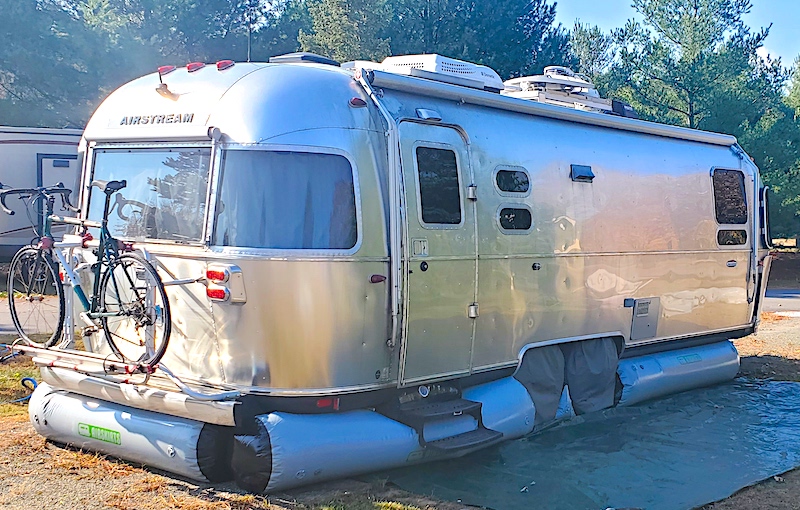
AirSkirts uses inflatable tubes placed around the underside of the RV instead of panels or material attached to the coach.
The reason I like that approach is simple: we can set it up, take it down, pack it away, and use it again somewhere else without drilling holes or installing snaps on the RV.
We actually tested AirSkirts on our Class A in roughly 30-degree weather.
Without the skirting, we heated the RV to 70°F and watched it fall to 58°F after one hour while the outside temperature was around 33°F to 35°F.
Then we installed AirSkirts, reheated the RV to 70°F, and ran the same basic test again. This time the outside temperature was colder, around 30°F, and it was windier. After one hour, the inside temperature was still 65°F.
That was a 12-degree drop without skirting versus a 5-degree drop with AirSkirts.
This was not a laboratory test, and I would never pretend it was. But the difference was big enough that we noticed it.
You can see the full setup, test, pros, cons, and what we learned in our AirSkirts RV skirting review.
If you want to check current sizing and pricing, you can see AirSkirts RV skirting kits here. Use code RVBlogger to save $100 on your order.
DIY vs. Brand-Name RV Skirting: Which Is Better?
I do not think there is one answer for every RVer.
If you are staying put for most of the winter and cost matters most, I would choose DIY foam board.
If you travel frequently and want something reusable without modifying the RV, I would choose AirSkirts.
If appearance and a custom fit matter most and you plan to keep the same RV for years, custom vinyl or snap-on skirting may be worth the extra money.
What About an Enclosed or Heated Underbelly?
An enclosed or heated underbelly definitely helps, but I would not assume that means you can ignore skirting in serious cold.
Skirting can reduce the cold wind reaching the underbelly and help the heat already being sent into that space do its job more efficiently.
But again, it is only one layer of protection. Your furnace still matters because many RVs rely on furnace heat to warm the underbelly.
Can RV Skirting Prevent Frozen Pipes and Tanks?
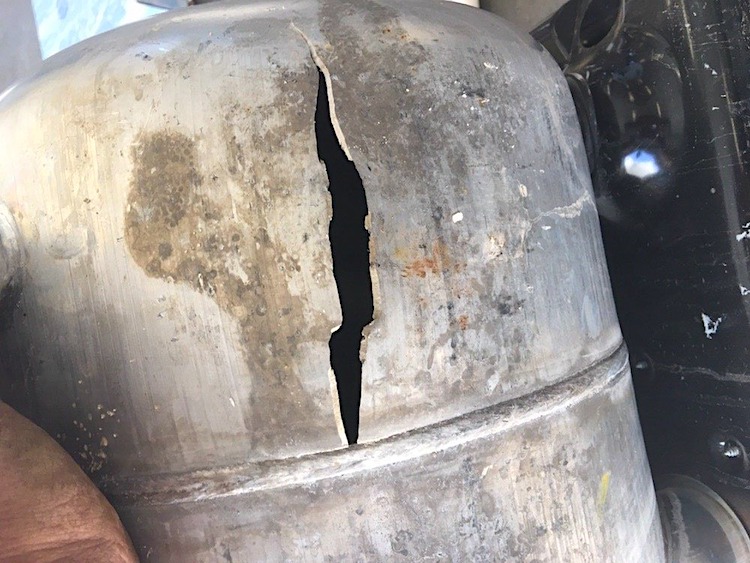
Skirting can help reduce the risk, but I would never promise that it will prevent freezing by itself.
Whether something freezes depends on temperature, wind, how long the cold lasts, whether the underbelly is heated, how exposed the plumbing is, whether water is moving, and what other winter-protection steps you are using.
If you are camping in sustained freezing temperatures, you need a complete cold-weather plan rather than relying on skirting alone.
My Bottom Line
I used to look at DIY skirting and think, why spend more money than you have to?
I still think DIY foam board is probably the best value if your RV is going to sit in one place for a long winter stay.
But for the way Susan and I RV, I would rather pay more for something we can use over and over without cutting panels, taping material to the RV, or rebuilding the setup at every campground.
That is why AirSkirts makes more sense for us.
The best RV skirting is not necessarily the cheapest or the most expensive. It is the one that actually fits how you camp.
Related Reading
AirSkirts RV Skirting Review: We Tested It in 30°F Weather
DIY RV Skirting Using Foam Board Insulation
How Cold Does It Have to Get Before RV Pipes and Tanks Freeze?
12 Best Ways to Insulate a Travel Trailer for Winter
Mike Scarpignato – Bio
Mike Scarpignato founded RVBlogger.com with his wife, Susan, in 2018 to help new and experienced RVers make better decisions about buying, owning, and traveling in an RV.
Mike has decades of camping experience and has traveled extensively in both a Gulf Stream Conquest Class C and a Thor Challenger Class A motorhome. He and Susan spend much of the year on the road, attend RV shows, visit dealerships, and tour RVs across the country.
Through RVBlogger.com and the RVBlogger YouTube channel, Mike shares practical, first-hand advice about RV buying, floor plans, ownership, maintenance, gear, campgrounds, and the RV lifestyle.

I used black RV underliner from Recpro for my skirting, attached with Velcro and a few zip ties at the corners. Think plastic cardboard. Works well, cost about $300 for a roll, and looks great. Easy to adjust with a razor knife and provides adequate insulation. Recommend if you are the least bit handy.
Where can I list used Airskirts for sale?
Hi Beatrice,
I would guess you could sell used AirSkirts on Craigslist or Facebook Marketplace.
All the best!
Miked