Thanks for your support! If you make a purchase using our links in this article, we may make a commission. And, as an Amazon Associate, I earn from qualifying purchases. See the full disclosure here.
Published October 20, 2021 | Last updated May 5, 2026
The best RV for a beginner is usually not the biggest RV, the fanciest RV, or the one with the most buttons, slides, lights, gadgets, and screens.
In my opinion, the best RVs and campers for beginners are the ones that are easy to drive or tow, easy to set up, easy to maintain, and simple enough that your first few camping trips are actually fun.
That matters more than most first-time buyers realize.
When you are new to RVing, everything feels unfamiliar. Hooking up water. Plugging into power. Leveling the RV. Dumping tanks. Backing into a campsite. Using propane. Managing batteries. Checking tire pressure. Learning what all the switches do.
Now add slide-outs, auto-leveling, outdoor kitchens, tank heaters, solar controllers, multiple TVs, power bunks, complicated control panels, and ten other features you barely understand yet.
That is where many beginners get overwhelmed.
Susan and I have owned and rented different kinds of RVs, and we have reviewed hundreds of RVs through RVBlogger and our YouTube channel. We rented before we bought, which was one of the smartest things we did. But we still made mistakes when we bought our first RV.
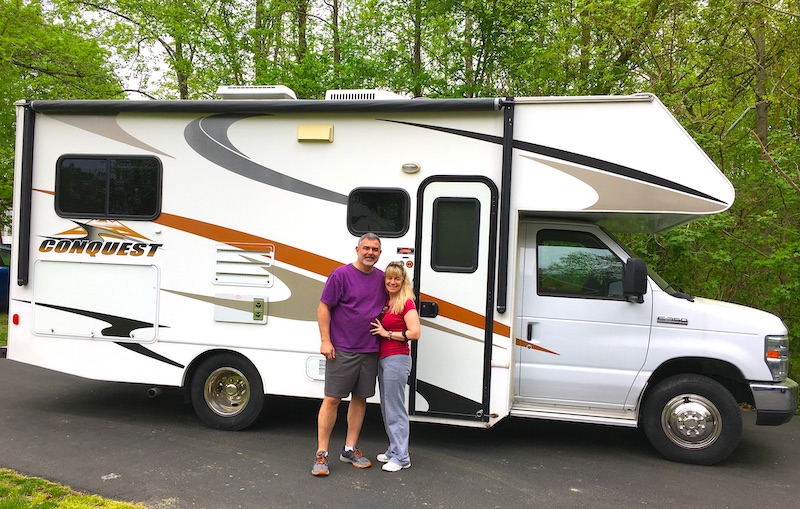
Our first RV was a used Class C motorhome we found on Facebook Marketplace. It had under 9,000 miles on it and cost about the same as an expensive travel trailer. For us, that was the right direction because it gave us a beginner-friendly motorhome without spending new-RV money.
But we also learned quickly that RVs are not like cars. Things break. Systems need maintenance. Water leaks matter. And the more complicated the RV is, the more there is to learn, manage, and fix.
So this article is not going to be a list of specific RV models that may be discontinued next year.
Instead, I want to help you understand what makes an RV beginner-friendly, which RV types usually make the most sense for first-time buyers, and which ones I would be careful with until you have more experience.
What Makes an RV Beginner-Friendly?
A beginner-friendly RV is not just an RV with a low price.
Cheap can still be complicated. Small can still be poorly designed. And expensive does not always mean easier.
To me, a good beginner RV usually has these qualities:
It is easy to drive or tow.
It is simple to set up at the campground.
It does not have too many slide-outs or complicated systems.
It has enough space to be comfortable without being too large to manage.
It has fewer things that can break.
It fits your actual travel style.
It fits your budget after you include insurance, repairs, gear, fuel, storage, and campground fees.
That last part is important.
A lot of beginners only ask, “Can I afford the payment?”
That is the wrong question.
You also need to ask, “Can I afford to use it, maintain it, store it, repair it, and learn with it?”
Because if you buy too much RV too soon, it can steal the joy out of camping.
My Best Advice: Choose Simple Over Fancy
I know the fancy RVs are tempting.
The big fifth wheels with residential kitchens are beautiful. Class A motorhomes with multiple slides feel like apartments. Travel trailers with outdoor kitchens, fireplaces, bunk rooms, and giant entertainment centers look great at RV shows.
But beginner buyers should be careful.
Every feature has a tradeoff.
Slide-outs give you more room, but they can leak, get stuck, need adjustment, and add weight.
Outdoor kitchens are convenient, but they take up storage space and add more plumbing, wiring, and appliances.
Auto-leveling is wonderful when it works, but it is another system to understand and maintain.
Power awnings are nice, but one surprise wind gust can ruin your day.
That does not mean these features are bad. We have owned RVs with plenty of features, and some of them are absolutely worth having.
But for a first RV, simple is often better.
The goal of your first RV should be to get camping, learn the lifestyle, and figure out what really matters to you before you spend a fortune.
Best Overall Beginner Motorhome: A Used Class C RV
If someone asks me for the best beginner-friendly motorhome, I usually point them toward a used Class C.
That is what Susan and I bought in 2017, and we still own it.
A Class C motorhome usually has a van or truck cab up front with the RV living space built behind it. Many have a cabover bunk above the driver and passenger seats.
For beginners, a Class C gives you a good balance.
You get a real bathroom, real kitchen, beds, storage, holding tanks, heat, air conditioning, and a living space you can use without towing a trailer.
Compared to a Class A, a Class C usually feels less intimidating to drive. Compared to a Class B camper van, a Class C gives you more usable living space.
That is why I think a Class C is one of the best beginner RV choices if you want a motorhome.
Why a Used Class C Can Be a Smart First RV
I like used Class C motorhomes for beginners because they can be a better financial learning curve.
Most people do not buy their perfect RV the first time.
You think you know what you want, but you really do not know until you start camping. After a few trips, you may realize the bed is too small, the shower is annoying, the storage is not enough, or you hate the dinette.
That is normal.
Buying used can reduce the depreciation hit if you decide to change RVs later.
Susan and I bought our used Class C from Facebook Marketplace. It had low mileage and gave us a way into RV ownership without buying brand new.
Was it perfect? No.
But it helped us learn.
And that is what a first RV should do.
Why Class C RVs Are Easier for Beginners
A Class C can be easier because setup is usually pretty straightforward.
Pull into the site. Level the RV. Plug in power. Connect water if needed. Hook up sewer if you are staying a while. Put out the awning if the weather is good. You are basically camping.
There is no hitching and unhitching a trailer. No worrying about sway bars. No backing a long travel trailer while your spouse is trying to guide you in with hand signals you do not understand yet.
And yes, Class C motorhomes can still be challenging. You still need to learn how to drive something bigger than a car. You need to watch your height, width, mirrors, and turning radius.
But for many beginners, a small or mid-sized Class C is a very manageable place to start.
Best Beginner Towable RV: A Simple Travel Trailer
If you already have the right tow vehicle, a simple travel trailer can be one of the best campers for beginners.
Travel trailers are popular for a reason.
They come in all sizes. They can be much less expensive than motorhomes. They do not have an engine to maintain. And once you set up at the campground, you can use your tow vehicle to go sightseeing, get groceries, or explore the area.
Susan owned a travel trailer for over 10 years before we bought our motorhome. She used it to take her daughters camping, and it worked well for that stage of life.
For many families, a travel trailer is the most practical first RV.
But I would keep it simple.
As a beginner, I would rather see someone buy a smaller, lighter, no-slide or single-slide travel trailer that they can tow safely than a huge trailer packed with features that pushes their vehicle to the limit.
What To Look For In A Beginner Travel Trailer
Look for a travel trailer that is easy to tow, easy to level, and easy to live in.
A beginner-friendly travel trailer should have:
A floor plan that works without needing three slide-outs
A real bed you do not have to make every night
A bathroom you can actually use
Enough storage for your gear
A refrigerator you can access during travel stops
A weight your tow vehicle can safely handle when fully loaded
A simple setup process
Do not trust dry weight alone.
Dry weight does not include your camping gear, food, water, propane, batteries, tools, chairs, grill, clothes, or all the stuff you will actually bring.
You need to understand loaded weight, payload, hitch weight, and your vehicle’s real towing limits.
This is where many beginners get into trouble.
A dealer may say, “Your truck can tow it.”
That does not mean it is a good idea.
Best Camper For Budget-Minded Beginners: A Used Pop-Up Camper
A pop-up camper can be a good first camper for the right person.
They are usually affordable, lightweight, and easier to store than larger RVs. If you are moving up from tent camping, a pop-up can feel like a big upgrade.
But I want to be honest.
Pop-ups are more work than many beginners expect.
Susan owned a pop-up camper and sold it after one season. It was too much work. And if it rained and the camper had to be put away wet, she had to set it back up later just to dry it out.
That gets old fast.
Pop-ups also have more canvas, more setup, less insulation, less storage, and fewer amenities than a hard-sided camper.
So I would not call a pop-up the easiest camper for beginners.
I would call it one of the most affordable ways to start camping if you are willing to do the work.
Who Should Consider A Pop-Up Camper
A pop-up may make sense if you are on a tight budget, have a smaller tow vehicle, camp mostly in good weather, and do not mind setup and takedown.
It is also a decent step up from tent camping.
Who Should Avoid A Pop-Up Camper
Avoid a pop-up if you want quick setup, easy storage access, good protection from weather, a real bathroom, or a camper that feels more like an RV than a tent.
For some people, a small hard-sided travel trailer is worth the extra money.
Best Beginner RV If You Want Tiny And Simple: A Teardrop Camper
A teardrop camper can be a great beginner camper if you want something small, simple, and easy to tow.
Most teardrops give you a sleeping space inside and a small kitchen or galley outside in the back. Some are very basic, while others include off-road packages, solar, heat, air conditioning, and upgraded kitchens.
The big advantage is simplicity.
There is less to maintain, less to tow, less to store, and less to break.
That can be perfect for solo campers, couples, weekend trips, and people who want something easier than tent camping.
But you need to be realistic.
A teardrop is not a small travel trailer. You usually cannot stand up inside. You may not have a bathroom. You may not have much storage. And if it rains all weekend, you may feel trapped.
Who Should Consider A Teardrop Camper
A teardrop makes sense if you want a lightweight, simple camper for short trips and you do not need much interior space.
Who Should Avoid A Teardrop Camper
Avoid a teardrop if you need a real bathroom, indoor living space, bunks, or room to hang out during bad weather.
Best Beginner RV For More Living Space: A Small Fifth Wheel
A fifth wheel can be wonderful, but I would be careful recommending one as a first RV.
Fifth wheels usually offer some of the best living space in the RV world. Many full-timers love them because they feel more residential than travel trailers.
The towing experience can also be better than a travel trailer because the hitch sits in the bed of the truck instead of behind the bumper.
But fifth wheels require a serious truck.
That is where many people underestimate the cost.
Susan and I rented a fifth wheel with delivery and setup before we ever considered buying one. We did not have the right truck to tow it, so the owner delivered it to our campsite, set it up, and picked it up when we were done.
That rental was a win because we did not buy a fifth wheel.
Sometimes figuring out what will not work is even more valuable than figuring out what will work.
If we had bought the wrong RV, then had to sell it, take the depreciation hit, and buy something else, that would have been an expensive lesson.
Renting helped us avoid that mistake.
Who Should Consider A Small Fifth Wheel
A small fifth wheel may make sense if you already own the right truck, want more living space, and plan to take longer trips.
Who Should Avoid A Fifth Wheel As A First RV
Avoid a fifth wheel if you do not already have the right truck, are nervous about towing, or only plan to camp a few weekends a year.
A fifth wheel can be great, but it is not usually the simplest way to start.
Best Beginner RV For Solo Travelers Or Couples: A Class B Camper Van
A Class B camper van is one of the easiest RVs to drive and park.
That makes it appealing for beginners.
You can take it into towns, fit into more parking lots, drive through national parks more easily, and travel without towing anything.
For solo travelers or couples who want mobility, a Class B can be a great RV.
But here is the downside:
They are small, and they can be expensive.
Many Class B camper vans cost as much as larger RVs, but they have much less living space. The bathroom is usually tiny, the kitchen is compact, storage is limited, and the bed may require daily setup.
For the right person, that is fine.
For a lot of beginners, it gets old.
Who Should Consider A Class B Camper Van
A Class B is great for solo travelers, couples, weekend explorers, national park trips, and people who move often instead of staying in one campground for a week.
Who Should Avoid A Class B Camper Van
Avoid a Class B if you need room to spread out, travel with kids, bring a lot of gear, or want a comfortable bathroom and living area.
RVs I Would Be Careful With As A Beginner
Some RVs are not bad. They are just not the easiest place to start.
A large Class A motorhome can be very comfortable, and we upgraded to one in 2021 because we are on the road so much. But for a brand-new RVer, a big Class A can be intimidating, expensive, and harder to maneuver.
A large fifth wheel can be amazing for full-time RVing, but it requires the right truck and more towing confidence.
A big toy hauler can be perfect if you truly need the garage, but they are heavier, more expensive, and sacrifice living space.
A truck camper can go places other RVs cannot, but the space is tight and payload numbers matter.
A skoolie or bus conversion can be cool, but it is usually more of a DIY construction project than a simple way to start RVing.
None of these are wrong.
But for most first-time buyers, I would start simpler.
Used RVs Are Usually Better For Beginners
I know everyone loves the idea of a brand-new RV.
New smell. New furniture. New appliances. Nobody else has used it. It feels clean and exciting.
But I still think many beginners should strongly consider buying used.
RVs depreciate. And most first-time buyers do not keep their first RV forever.
After a year or two, you may realize you want something smaller, bigger, easier to tow, easier to drive, or better suited for your camping style.
That is normal.
Buying used may help you avoid the biggest depreciation hit.
It can also give you room in the budget for repairs, upgrades, camping gear, storage, insurance, and travel.
But used does not mean careless.
You still need to inspect it carefully.
Water damage is the big one. Check the roof, ceiling, walls, floors, windows, corners, storage bays, and anywhere water could sneak in.
A used RV can be a smart buy.
A neglected used RV can become a money pit.
Rent Before You Buy Your First RV
This is one of the strongest recommendations I can make.
Rent before you buy.
Susan and I rented a Class C before we bought ours, and that experience helped us understand what we liked and did not like.
We also rented a fifth wheel with delivery and setup, and that experience helped us avoid buying something that probably would not have worked for us at the time.
That is a win.
A rental can teach you things a dealership walkthrough cannot.
You may discover that you love Class C motorhomes. Or you may discover that you hate driving a motorhome and would rather tow a travel trailer.
You may think you want a fifth wheel, but after a weekend you may realize it is more RV than you need.
You may think a tiny camper is perfect, then realize you need a bathroom.
That kind of knowledge is worth paying for.
A site like Outdoorsy can be a good place to rent different types of RVs before you spend serious money buying one. I especially like the option of delivered rentals if you want to test a travel trailer or fifth wheel but do not have the right tow vehicle yet.
My Advice Before You Buy Your First RV
Before buying your first RV, slow down.
Do not buy based only on emotion.
Do not buy the biggest RV you can afford.
Do not assume more features means better.
Do not trust dry weight.
Do not assume your first RV will be your forever RV.
Instead, look for simple, usable, beginner-friendly.
Here is what I would prioritize:
Easy to drive or tow
No slides, or only one slide if you really need it
A floor plan that works even with the slide in
A real bed
A bathroom you can comfortably use
Enough storage for normal camping gear
A simple setup process
A price that leaves room for repairs and gear
A size that fits the campgrounds you actually want to visit
An RV you will use often enough to justify owning
That is the kind of RV that helps beginners enjoy camping instead of fighting the camper.
Best RVs And Campers For Beginners By Situation
1. Best Beginner Motorhome: Small Used Class C
A small used Class C is my favorite beginner motorhome choice. It gives you enough comfort to enjoy real RV travel without jumping straight into a huge motorhome.
It is also easier to set up than most towable RVs, which matters when you are new.
2. Best Beginner Towable Camper: Simple Travel Trailer
A simple travel trailer is probably the best towable RV for many beginners, especially if you already have the right tow vehicle.
Keep it light, manageable, and easy to tow.
3. Best Budget Camper: Used Pop-Up Camper
A used pop-up can be a good budget option, but only if you are okay with setup and weather-related hassles.
It is not the easiest camper, but it can be one of the cheapest ways to start.
4. Best Tiny Camper: Teardrop Camper
A teardrop camper is simple, lightweight, and easy to store.
It works best for short trips, solo campers, and couples who do not need much space.
5. Best Full-Time Beginner Option: Small Fifth Wheel
If you already have the right truck and want more living space, a small fifth wheel may work.
But I would rent one first before buying.
6. Best Beginner RV For Mobility: Class B Camper Van
A Class B is easy to drive and great for exploring, but it is tight inside and usually expensive.
It is best for solo travelers or couples who value mobility over space.
FAQ About The Best RVs And Campers For Beginners
1. What is the easiest RV for beginners to use?
In my opinion, a small used Class C motorhome is one of the easiest RVs for beginners to use because setup is simple, you do not have to tow, and you still get a real bathroom, kitchen, and sleeping space.
2. What is the best camper for beginners on a budget?
A used pop-up camper or small used travel trailer can be a good budget option. I would lean toward a small hard-sided travel trailer if you can afford it because pop-ups require more setup and can be frustrating in wet weather.
3. Should beginners buy a new or used RV?
Many beginners should consider buying used. Your first RV may not be your forever RV, and buying used can reduce the depreciation hit if you decide to change RVs later. Just make sure you inspect carefully for water damage.
4. Are slide-outs bad for beginner RVers?
Slide-outs are not bad, but they add complexity. They can leak, get stuck, or need maintenance. For a first RV, I like simple floor plans with no slides or only one slide if the extra space is really needed.
5. Should I rent an RV before buying one?
Yes. Renting before buying can save you from an expensive mistake. Susan and I rented a Class C before buying ours, and we also rented a fifth wheel with delivery and setup. That helped us learn what worked and what did not before spending a lot more money.
Final Thoughts On The Best RVs And Campers For Beginners
The best RV for a beginner is the one that makes camping easier, not harder.
That usually means simple, manageable, and practical.
A used Class C can be a great first motorhome. A simple travel trailer can be a great first towable camper. A small hard-sided camper may be better than a pop-up if you hate setup. A delivered rental can help you test an RV type before you buy it.
The wrong first RV can cost you a lot of money, especially if you have to sell it quickly and buy something else.
The right first RV helps you learn, travel, camp, and enjoy the lifestyle without feeling overwhelmed every time you pull into a campground.
My best advice is simple:
Rent first if you are unsure.
Buy used if it makes sense.
Keep it simple.
Avoid buying too much RV too soon.
And choose the RV you will actually use, not the one that only looks good at the dealership.
Related Resources:
Mike Scarpignato – Bio
Mike Scarpignato founded RVBlogger.com with his wife, Susan, in 2018 to help new and experienced RVers make better decisions about buying, owning, and traveling in an RV.
Mike has decades of camping experience and has traveled extensively in both a Gulf Stream Conquest Class C and a Thor Challenger Class A motorhome. He and Susan spend much of the year on the road, attend RV shows, visit dealerships, and tour RVs across the country.
Through RVBlogger.com and the RVBlogger YouTube channel, Mike shares practical, first-hand advice about RV buying, floor plans, ownership, maintenance, gear, campgrounds, and the RV lifestyle.