
Thanks for your support! If you make a purchase using our links in this article, we may make a commission. And, as an Amazon Associate, I earn from qualifying purchases. See the full disclosure here.
Published January 8, 2021 | Last updated September 2, 2026
When Susan and I were shopping for our Class A, we wanted a diesel pusher.
We liked the idea of the smoother ride, more torque, quieter cockpit, and heavier-duty chassis. But we kept running into the same problem: we could not find a diesel floor plan we actually wanted to live in.
Then we found the Thor Challenger 37FH.
The floor plan was exactly what we wanted. And because it was a gas Class A, we could buy it new instead of stretching our budget for a used diesel and compromising on the layout.
That experience changed the way I answer the gas-vs.-diesel question.
I would not choose a motorhome based on the engine first. I would choose the floor plan and coach that fit how I wanted to travel, then decide whether the drivetrain made sense.
Gas vs. Diesel RV: The Short Answer
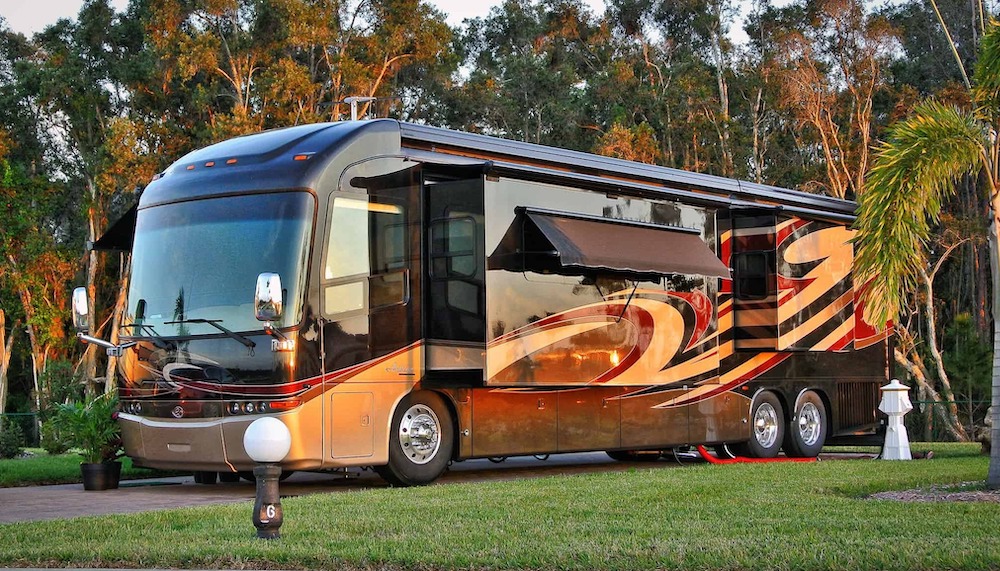
A diesel motorhome usually gives you more torque, more towing capability, a smoother ride, and a quieter driving experience—especially when you are comparing a diesel pusher with a front-engine gas Class A.
A gas motorhome is usually less expensive to buy and can be less expensive and simpler to service.
But I do not think that automatically makes diesel “better.”
The better RV is the one that gives you the floor plan, cargo capacity, towing ability, ride, serviceability, and price that fit the way you actually RV.
Why We Bought a Gas Class A Even Though We Wanted Diesel
Our decision came down to two things: floor plan and price.
We could not find a diesel pusher with a floor plan we liked nearly as much as the Challenger 37FH.
And the diesels we were looking at were expensive enough that we would have needed to buy used.
There is nothing wrong with buying a used diesel. In fact, a well-maintained used diesel pusher can be a great buy.
But in our case, the gas Challenger let us buy a brand-new RV with the exact floor plan we wanted instead of compromising just so we could say we owned a diesel.
I am still happy with that decision.
Gas vs. Diesel Purchase Price
This is often the biggest difference.
Diesel pushers typically cost more because you are not just paying for a diesel engine. You are often getting a heavier chassis, rear-engine layout, air suspension, air brakes, higher towing capacity, larger tanks, and more expensive coach construction.
That is why I do not like comparing a gas Class A and diesel pusher as though the engine is the only difference.
For us, the price difference was large enough to change the whole buying decision.
If diesel forces you into an older coach, a floor plan you do not like, or a payment you are uncomfortable with, I would think very carefully before making that trade.
Fuel Economy: Diesel Usually Wins, But Not by Enough to Ignore the Purchase Price
Diesel motorhomes often get somewhat better fuel economy than comparable large gas motorhomes, but there is so much variation by size, weight, speed, terrain, towing, and chassis that I would not buy based on a generic MPG chart.
For a real-world reference, our old gas Class C averaged around 9 mpg and our gas Class A averages around 7 mpg.
Driving slower helps. So does keeping weight under control and maintaining proper tire pressure.
Diesel may save fuel over a long ownership period, but I would run the math against the actual purchase-price difference. A couple MPG usually does not erase a six-figure difference in purchase price.
Maintenance: Gas Is Usually Simpler, Diesel Can Get Expensive Fast
Gas motorhomes generally have simpler engine and emissions systems and more service options.
Diesel pushers can require more expensive oil changes, more fluid, larger filters, chassis service, air-system maintenance, and diesel-specific technicians.
Modern diesel engines also bring emissions equipment such as DEF and diesel particulate filters into the equation.
I would not say diesels automatically break down less. They are heavy-duty engines, but when a diesel or emissions-related repair does happen, it can be expensive.
Gas is not maintenance-free either. Our Class A still needs oil changes, chassis service, brakes, tires, fluids, and all the normal motorhome maintenance.
The difference is that I generally expect a gas drivetrain to be cheaper and easier to find service for.
How Long Do Gas and Diesel Motorhome Engines Last?
Diesel engines are designed for heavy-duty use and can have a very long service life when maintained properly.
But I would not buy a diesel pusher just because someone tells you the engine can go half a million miles.
Most RV owners will never put enough miles on either engine for engine longevity to become the reason they replace the coach.
The house portion of the RV—roof, slides, appliances, plumbing, electrical system, seals, suspension components, and interior—can become the bigger ownership issue long before the engine wears out.
So yes, diesel has an advantage in potential engine longevity. For many RV buyers, I just do not think that should be near the top of the decision list.
Ride Quality Is Where I Understand the Diesel Appeal
This is the area where I would most like to have the diesel-pusher advantage.
Our Thor Challenger rides on the Ford F-53 chassis, and in stock form it is a bumpy ride.
I would go as far as saying we probably would not like the ride very much if we had not installed LiquidSpring suspension.
LiquidSpring transformed the way our Class A rides and handles. It did not turn our gas coach into a diesel pusher, but it addressed the biggest complaint we had with the F-53 chassis.
If you are considering a gas Class A but hate the way an F-53 coach rides on a test drive, I would at least know that suspension upgrades exist. They are not cheap, so that cost belongs in your comparison.
We also have a full article on RV suspension upgrades for motorhomes.
Why Diesel Pushers Are Quieter Up Front
One major reason diesel pushers feel quieter is simple: the engine is behind you.
In a front-engine gas Class A, the engine is right under and between the driver and passenger.
When the transmission downshifts on a grade, you hear it.
A rear-engine diesel pusher puts the powertrain much farther away from the cockpit. Combine that with a heavier chassis and air suspension on many diesel pushers, and the difference in driving feel can be substantial.
Towing and Cargo Capacity Favor Diesel—But Check the Actual Numbers
Diesel pushers often have an advantage in towing capacity and cargo carrying capacity, especially in larger coaches.
That matters if you want to tow a heavier vehicle, trailer, or stacker, or if you carry a lot of gear.
But do not assume every diesel beats every gas coach.
Read the actual GVWR, GCWR, hitch rating, and cargo carrying capacity for the exact motorhome you are considering.
We deliberately tow a 2-door Jeep Wrangler behind our Class A partly because I pay close attention to weight and cargo capacity.
Insurance Is About More Than Gas vs. Diesel
It is easy to say “diesel costs more to insure,” but that is too simplistic.
Insurance companies care about the value of the RV, repair costs, coverage limits, usage, location, driving history, deductibles, and a lot more.
A $500,000 diesel pusher will usually cost more to insure than a $150,000 gas Class A because you are insuring a much more valuable vehicle—not just because diesel fuel goes in the tank.
Get actual insurance quotes on the specific RVs you are comparing before you buy.
Gas vs. Diesel Motorhome Comparison
| Factor | Gas Motorhome | Diesel Motorhome |
|---|---|---|
| Purchase price | Usually lower | Usually higher |
| Fuel economy | Usually lower | Usually somewhat better |
| Routine service | Usually cheaper and easier to find | Usually more expensive and specialized |
| Ride quality | Varies; F-53 can be harsh | Diesel pushers often smoother |
| Cab noise | More engine noise in front-engine Class As | Rear-engine pushers are usually quieter up front |
| Towing | Enough for many RVers | Often higher capacity |
| Cargo capacity | Must check carefully | Often stronger on larger chassis |
| Engine longevity | Plenty for most RV use | Heavy-duty diesel advantage |
| Emissions complexity | Generally simpler | DEF/DPF and related systems |
| Best fit | Value-focused buyers and many first-time Class A owners | Heavy travelers, heavy towing, premium ride buyers |
Who Should Buy a Gas Motorhome?
I think gas makes a lot of sense if you are trying to maximize floor plan and features for the money.
It can also be a smart choice for first-time Class A buyers who do not need huge towing capacity and would rather spend the difference on the coach itself, travel, or upgrades.
That is basically what we did.
We bought the floor plan we loved and later fixed the biggest ride-quality weakness with LiquidSpring.
Who Should Buy a Diesel Motorhome?
I would lean harder toward diesel if I were buying a very large luxury coach, towing heavy, carrying a lot of cargo, driving long distances constantly, or if ride quality and cockpit noise were near the top of my priority list.
I would also consider a used diesel before buying a new gas coach if the used diesel had the right floor plan, good maintenance records, passed an independent inspection, and fit the budget.
What I would not do is buy a diesel floor plan I did not like just because diesel looks better on a comparison chart.
What I Would Choose Today
If I were making the same decision again, I would still choose the Challenger 37FH over a diesel pusher with a floor plan I liked less.
The F-53 ride was a real negative, and I do not want to minimize that. LiquidSpring made a huge difference for us.
But once we solved the ride issue, we had the floor plan we wanted, a coach we could afford new, and a motorhome that has taken us all over the country—including over the Rockies while towing our Jeep.
That is why my answer is no longer “diesel is always better.”
The right motorhome is better. The engine is only one part of choosing it.
Related Reading
Class A vs. Class C Motorhome: How to Choose
Best RV Suspension Upgrades for Motorhomes
What Is the Average Gas Mileage for a Class C RV?
Mike Scarpignato – Bio
Mike Scarpignato founded RVBlogger.com with his wife, Susan, in 2018 to help new and experienced RVers make better decisions about buying, owning, and traveling in an RV.
Mike has decades of camping experience and has traveled extensively in both a Gulf Stream Conquest Class C and a Thor Challenger Class A motorhome. He and Susan spend much of the year on the road, attend RV shows, visit dealerships, and tour RVs across the country.
Through RVBlogger.com and the RVBlogger YouTube channel, Mike shares practical, first-hand advice about RV buying, floor plans, ownership, maintenance, gear, campgrounds, and the RV lifestyle.

Great info, I understand more about the differences than I did thankyou
Thanks Lisa,
Glad you liked the article.
Mike