Thanks for your support! If you make a purchase using our links in this article, we may make a commission. And, as an Amazon Associate, I earn from qualifying purchases. See the full disclosure here.
If you are buying your first RV, one of the biggest decisions is whether to buy new or used.
Susan and I have done both.
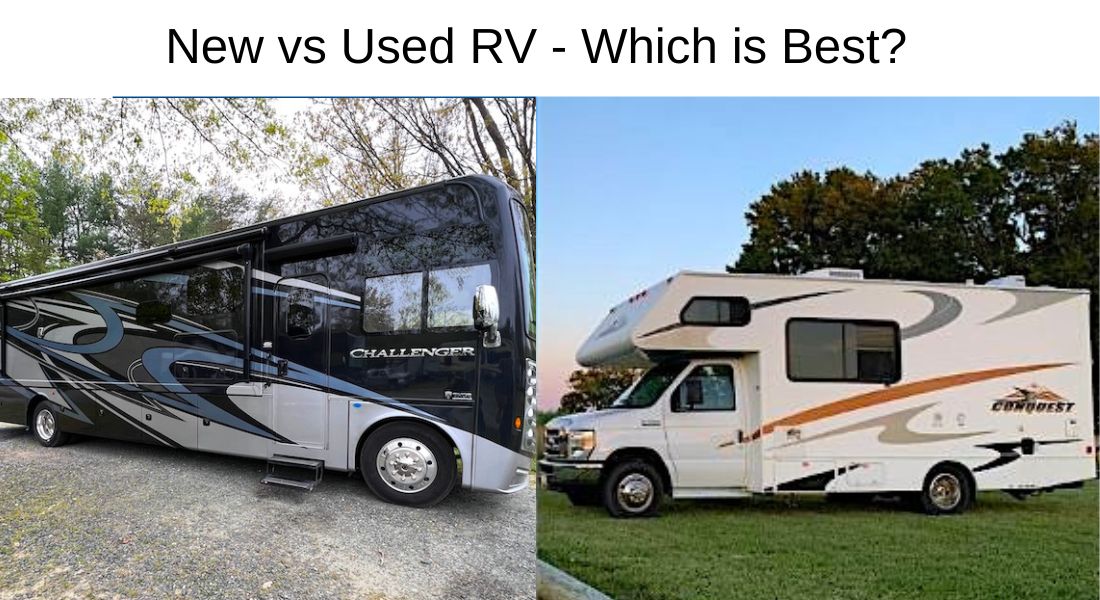
We bought a used Class C as our first RV.
Later, we bought a brand-new Class A motorhome.
After going through both experiences, I usually recommend that first-time RV buyers seriously consider buying used.
Not because used is always better.
It is not.
But RVs can lose value fast, and first-time buyers are also the people most likely to discover after a year or two that they bought the wrong size, floor plan, or type of RV.
That can be an expensive lesson when you buy new.
My short answer is this:
Buy used if saving money and avoiding the biggest depreciation hit matter most. Buy new if getting exactly what you want, having a factory warranty, and knowing the RV’s full history matter more to you.
And whichever way you go, I would get an independent RV inspection before you sign the final paperwork.
Why We Usually Recommend Used for First-Time RV Buyers
The biggest reason is simple.
Someone else already took the first depreciation hit.
RVs generally go down in value over time, and they can lose value quickly.
An RV that costs $60,000 new might be worth only around $30,000 five years later depending on the model, condition, market, and what the first owner actually paid.
That does not mean every RV loses exactly 50% in five years.
Some hold their value much better than others.
But the basic lesson is still true: new RV buyers usually absorb the steepest part of the value drop.
When you buy used, the first owner has already taken at least part of that hit.
That is a big deal for a first-time buyer because your first RV may not be your last RV.
You may think you want a bunkhouse and later decide you hate making beds every night.
You may think a 38-foot motorhome sounds great and later decide you want something smaller.
You may buy a travel trailer and discover you would rather drive a motorhome.
Or you may find out that the bathroom, bed, storage, or road-mode access does not work as well as you thought it would.
If you make that discovery after buying used, you may lose less money when you change RVs.
Our article on how RV depreciation affects travel trailer value goes deeper into this.
Our Used Class C Felt Like a Better Deal
When we bought our used Class C, one thing I liked was that I felt we were getting more RV for the money.
I could compare it with other used RVs of similar age, mileage, condition, and features.
That made the price easier for me to understand.
But buying used came with a lesson too.
We later discovered that the RV had a roof leak.
There had been a stain in the cab-over area that we probably should have recognized as a warning sign before we bought it.
We did not know what we were looking for yet.
That experience is a big reason I tell buyers today that used does not mean cheap if you buy somebody else’s problems.
A good used RV can be an excellent value.
A neglected used RV with water damage, bad tires, old batteries, worn appliances, or poor maintenance can become a money pit.
The answer is not to avoid used RVs.
The answer is to inspect them properly before buying.
New RVs Can Be Discounted More Than Most Beginners Expect
One thing that surprised me when we bought our new Class A was how much room there was to negotiate.
The sticker price on a new RV is often not the price you should expect to pay.
Depending on the RV, dealer inventory, time of year, and market conditions, the discount can be substantial.
When we bought our Class A, I knew enough about RV pricing to negotiate hard.
That helped soften the depreciation hit.
This is important because comparing a used RV price with a new RV’s full MSRP can make the used RV look like a much better bargain than it really is.
Always compare the used price with the real negotiated price of a new one.
Our guide on how much you can negotiate off an RV explains why the sticker price should only be your starting point.
Brand New Does Not Mean Problem Free
This was probably the biggest surprise when we bought our Class A.
I expected some little punch-list items.
I did not expect a brand-new RV to have so many things that were incomplete, broken, loose, or not working correctly.
I later learned how much of the final checking and preparation falls on the dealer before the RV is delivered to the buyer.
Think about what that means at a large dealership.
A dealer may have 200 or more RVs sitting on the lot.
Each one may need systems checked, appliances tested, slides operated, plumbing tested, batteries checked, sealant inspected, and small factory problems corrected before delivery.
That is a monumental job.
My impression is that some dealers simply do not catch everything.
Sometimes it feels like they fix what the buyer finds.
That is why I do not accept this argument:
“I am buying new, so I do not need an inspection.”
I think that is exactly how buyers end up discovering problems after they have already driven away.
I Would Inspect a Brand-New RV Just as Seriously as a Used One
This is one of my strongest recommendations.
Get an independent RV inspection whether the RV is new or used.
With a used RV, you are looking for age, wear, poor maintenance, water damage, old tires, plumbing leaks, appliance problems, electrical issues, and repairs the previous owner may have made.
With a new RV, you are looking for factory defects, incomplete dealer prep, leaks, loose fittings, slide problems, appliance problems, electrical issues, damage from transportation, and things that simply were not tested well enough.
Do not let the dealer tell you the pre-delivery inspection replaces an independent inspection.
The dealer works for the dealer.
Your inspector works for you.
Read Is an RV Inspection Worth the Cost? and take our 115-Point RV Inspection Checklist with you.
The Best Time to Get Problems Fixed Is Before You Take the RV
This matters even more with a new RV.
Before you own it, the dealer has a strong reason to get the RV ready.
They want to finish the sale.
After you take it home, you become another service customer.
That can mean waiting for an appointment, waiting for diagnosis, waiting for parts, and sometimes leaving the RV at the dealership for weeks.
I would rather find 20 problems before delivery than find five problems after delivery.
Do not be afraid to say:
“I am not taking the RV until these items are fixed.”
That is not being difficult.
You are buying an expensive product and asking for it to work.
New RV Advantages
There are good reasons to buy new.
- You get the latest floor plans and features. If a new design solves a problem for you, used inventory may not exist yet.
- You know the RV’s history. There was no previous owner who ignored a leak, overloaded it, smoked in it, or did questionable repairs.
- You normally get a factory warranty. Coverage varies by manufacturer and component, but new buyers usually start with warranty protection.
- Financing may be easier. Lenders often prefer newer RVs, and manufacturers or dealers sometimes offer financing promotions.
- You may have more choices. You can shop colors, options, floor plans, and sometimes order exactly what you want.
- You are starting with new tires, batteries, appliances, fabrics, and furniture. At least in theory, you should have fewer age-related replacements immediately.
For a buyer who plans to keep the RV for many years and knows exactly what they want, buying new can make a lot of sense.
New RV Disadvantages
The biggest downside is money.
- Depreciation starts with you. You are the first owner, so you take the first drop in value.
- A higher purchase price can mean higher payments.
- Taxes, insurance, and financing costs can be higher because the RV is worth more.
- New does not mean defect-free. Our experience proved that to us.
- Warranty repairs can still be frustrating. A warranty does not help much if the RV sits at a dealership waiting for service.
- You may owe more than the RV is worth for a while. This is especially risky with a long RV loan.
That last point matters.
If you finance a new RV for a long term and then decide two years later that you bought the wrong RV, you may owe the bank more than the RV is worth.
That is called being upside down.
It can make trading into another RV very expensive.
Used RV Advantages
This is why I think used is worth a hard look for most beginners.
- The purchase price is usually lower.
- The first owner already absorbed part of the depreciation.
- You may get a higher-level RV for the same budget. Instead of buying an entry-level new RV, you may be able to buy a better-built used one.
- Many early factory problems may already have been repaired.
- You have more years and models to choose from.
- A lower purchase price may give you more room in your budget for repairs, upgrades, camping gear, and travel.
A clean two- or three-year-old RV can be a sweet spot for a first-time buyer.
It is old enough that someone else took the early depreciation but new enough that you may still get modern features and systems.
Used RV Disadvantages
Used comes with more unknowns.
- You do not know how the previous owner treated it.
- Water damage can be hidden.
- Tires and batteries may need replacement soon.
- Appliances and mechanical systems already have wear on them.
- The factory warranty may be expired or close to expiring.
- Financing can be harder or more expensive on older RVs.
- You may need to compromise on color, options, mileage, or floor plan.
That is why condition matters more to me than age.
I would rather buy a well-maintained six-year-old RV with records than a neglected three-year-old RV that looks shiny in the pictures.
Our article Are Old RVs Worth Buying? goes deeper into that decision.
Rent Before You Buy Your First RV
I think this is one of the smartest things a first-time buyer can do.
We rented before we bought.
Before buying our Class C, we rented a small Class C and actually traveled in it.
Later, when we were deciding whether we wanted a fifth wheel or a Class A, we rented a fifth wheel through Outdoorsy and had the owner deliver it and set it up at the campsite.
That taught us things a dealership walkthrough never could.
A floor plan can look great for 20 minutes on a dealer lot and feel completely different after two days of cooking, showering, sleeping, storing clothes, and trying to move around each other.
Renting can help you answer questions like:
- Can I comfortably drive this type of motorhome?
- Do I really want to tow a trailer?
- Is the bed comfortable?
- Is the shower actually usable?
- Can we use the bathroom with the slides in?
- Is there enough kitchen counter space?
- Do we have enough storage?
- Is this RV too big or too small?
You can search Outdoorsy for RV rentals near you.
A weekend rental costs money.
Buying the wrong RV costs a lot more.
Also read Should You Rent an RV Before You Buy One?.
Should You Get an Extended RV Warranty?
I think many buyers should at least look at the numbers.
This is especially true if you are buying a used motorhome or an RV with a lot of expensive systems.
We have an extended service contract through Wholesale Warranties on our Class A.
It has worked very well for us.
We have had slide repairs, a leveling-system repair, and other covered work, and we have saved more in covered repair costs than we paid for the warranty.
One of the biggest benefits for the way we travel is being able to use mobile RV technicians for eligible covered repairs, subject to the contract terms and authorization.
That can be much better than dropping the RV at a dealership and waiting.
An extended warranty is not a substitute for an inspection.
And it is not a reason to buy a bad RV.
Inspect first.
Buy the right RV.
Then decide whether repair coverage makes financial sense for you.
You can get a free quote from Wholesale Warranties here, and our article Protecting Your Travels With RV Warranties explains how the coverage works.
Is a One-Year-Old RV Better Than Brand New?
Sometimes I think it can be.
A lightly used RV that is one to three years old may give you a nice combination:
- The first owner took some depreciation.
- Many early defects may have already been found and repaired.
- The RV may still look and feel almost new.
- Modern features are still current.
- The price may be much easier to justify.
But do not assume a newer used RV is automatically good.
Some people sell an RV quickly because they bought the wrong one.
Others sell because the RV has been a nightmare.
That is another reason the independent inspection is so important.
When I Would Buy New
I would lean toward new when:
- You already have RV experience and know exactly what you want.
- You plan to keep the RV for a long time.
- The exact floor plan or feature you want is not available used.
- You are getting a very strong discount from MSRP.
- You want factory warranty coverage.
- You are comfortable dealing with possible new-RV punch-list repairs.
- Your budget can handle the depreciation without putting you in a bad financial position.
Buying new is not a mistake.
Buying new without understanding the depreciation and delivery risks can be.
When I Would Buy Used
I would lean toward used when:
- This is your first RV.
- You are still learning what type of RV fits you best.
- You want the most RV for your money.
- You want to reduce your exposure to early depreciation.
- You are willing to shop carefully and pay for an inspection.
- You can keep some money set aside for repairs and maintenance.
- You are comfortable walking away from an RV if the inspection finds serious problems.
That last part is important.
Do not fall in love with a used RV before the inspection.
There is always another RV.
New vs. Used RV Cost Example
Here is a simple example.
Suppose a new RV has a $70,000 sticker price.
You negotiate it down to $55,000.
A three-year-old version of the same RV is selling for $42,000.
The used RV saves you $13,000 up front.
But maybe the used RV needs:
- $1,500 in tires
- $500 in batteries
- $1,000 in maintenance and small repairs
Now your real savings are closer to $10,000.
That could still be a very good deal.
Or the inspection could find $15,000 worth of water damage, and suddenly the used RV is the terrible deal.
This is why I do not make the decision based only on new versus used.
I compare:
Purchase price + immediate repairs + financing + expected depreciation + condition.
That gives you a much better picture of what the RV is really going to cost.
Do Not Let the Monthly Payment Make the Decision for You
This is a trap.
A salesperson can often make an expensive RV seem affordable by stretching the loan over many years.
A lower monthly payment does not mean you got a good deal.
You may pay much more interest over the life of the loan, and you may stay upside down longer.
Always look at:
- The actual purchase price
- The interest rate
- The loan length
- The total amount of interest
- The amount you are putting down
- What the RV is likely to be worth if you sell in a few years
Our article How Do RV Loans and Financing Work? explains this in plain English.
My Advice for a First-Time Buyer
If I were buying my first RV again, this is the order I would follow.
- Rent the type of RV I think I want.
- Figure out the floor plan, size, and features that actually matter.
- Shop both new and used versions.
- Compare the real negotiated new price with used prices.
- Check financing before going to the dealership.
- Hire an independent inspector.
- Do not accept the RV until important problems are repaired.
- Decide whether an extended service contract makes sense.
- Keep enough cash available for repairs and RV gear after the purchase.
That process is not as exciting as walking onto a dealer lot and buying the first RV that looks awesome.
But it can save you a pile of money and frustration.
So, Should You Buy a New or Used RV?
For most first-time buyers, I lean toward used.
You can usually buy more RV for your money, and the first owner has already absorbed part of the depreciation.
That gives you some financial breathing room while you learn what you really want from RV ownership.
But I would rather see someone buy the right new RV than the wrong used RV just because somebody told them used is always smarter.
New can be a good choice when you know exactly what you want, negotiate well, plan to keep the RV a long time, and can comfortably afford the depreciation.
The worst choice is not new or used.
The worst choice is buying the wrong RV without understanding what it is really going to cost you.
Rent first.
Inspect before you buy.
Negotiate the price.
Understand the financing.
And leave yourself enough money to actually enjoy the RV after you own it.
Related Reading
Should You Rent an RV Before You Buy One?
12 Biggest RV Buying Mistakes First-Time Buyers Make
How to Choose an RV Floor Plan You Won’t Regret
Is an RV Inspection Worth the Cost?
115-Point RV Inspection Checklist
How Do RV Loans and Financing Work?
How to Buy a Used RV From a Private Seller
Protecting Your Travels With RV Warranties
Mike Scarpignato – Bio
Mike Scarpignato founded RVBlogger.com with his wife, Susan, in 2018 to help new and experienced RVers make better decisions about buying, owning, and traveling in an RV.
Mike has decades of camping experience and has traveled extensively in both a Gulf Stream Conquest Class C and a Thor Challenger Class A motorhome. He and Susan spend much of the year on the road, attend RV shows, visit dealerships, and tour RVs across the country.
Through RVBlogger.com and the RVBlogger YouTube channel, Mike shares practical, first-hand advice about RV buying, floor plans, ownership, maintenance, gear, campgrounds, and the RV lifestyle.