
Thanks for your support! If you make a purchase using our links in this article, we may make a commission. And, as an Amazon Associate, I earn from qualifying purchases. See the full disclosure here.
Published July 7, 2021 | Last updated July 11, 2026
What do RV model numbers and letters mean? Usually, the letters give you clues about the floor plan, while the numbers may identify the model or suggest its general size. But there is no universal RV naming system, and you should never assume the model number is the RV’s actual length.
Susan and I run into this problem constantly when we walk dealer lots and RV shows.
We cannot look at a model number and reliably know how long the RV is. Sometimes the number is close. Sometimes it is not even in the neighborhood.
A perfect example is the Jayco Jay Flight SLX 130BH. You might assume it is 13 feet long. It is not. It is not 130 inches long either. The current model is 16 feet 1 inch from end to end.
Ugh.
The BH gives us a useful clue because it means bunkhouse. The 130 does not give us a dependable overall length.
That is the most important lesson in this article: RV model numbers are clues, not measurements.
What Do RV Model Numbers Actually Mean?
An RV model number is primarily a manufacturer’s way of identifying a specific floor plan within a product line.
The number may refer to an approximate length, the interior box length, a size category, a floor-plan series, or nothing a shopper can decode without looking at the manufacturer’s specifications.
Manufacturers also change their naming systems. A number that meant one thing several years ago may not follow the same logic on a current model.
This is why I would not use an RV model number to make decisions about:
- Campsite length limits
- Driveway or storage space
- Tow-vehicle requirements
- Ferry reservations
- Length-restricted roads
- Whether the RV will fit in a national park campground
For those decisions, you need the official overall exterior length, not the model number.
Why Does the Model Number Rarely Match the RV’s Length?
There are several reasons.
Some manufacturers base the number loosely on the RV’s box length. That may leave out the travel-trailer tongue, rear bumper, spare tire, ladder, or other equipment.
Other manufacturers use a number that puts the RV into a general size class. An 18-series trailer may be closer to 22 feet overall. A 25-series trailer may be close to 30 feet.
Some numbers are simply internal floor-plan identifiers. Trying to convert them into feet, inches, or square footage will only make the shopping process more confusing.
The hitch is one of the biggest reasons travel-trailer model numbers and actual lengths do not match. The living box may be close to the number, but the complete trailer is longer once the A-frame and rear equipment are included.
Motorhome numbers can be closer to the overall length, but I still verify every one. Close is not good enough when a campground has a strict length limit or you are trying to fit the RV into a storage space.
Common RV Model Letters and Abbreviations
The letters are often more useful than the numbers because they usually describe the floor plan’s most important feature.
Here are some of the abbreviations we see most often:
| Letters | Common Meaning |
|---|---|
| BH | Bunkhouse |
| DBH | Double bunkhouse or double-size bunks |
| BHS | Bunkhouse with a slide or bunkhouse slide |
| RK | Rear kitchen |
| FK | Front kitchen |
| RL | Rear living room |
| FL | Front living room |
| RB | Rear bathroom |
| FB | Front bathroom |
| MB | Mid-bunk |
| ML | Mid-living or middle living area |
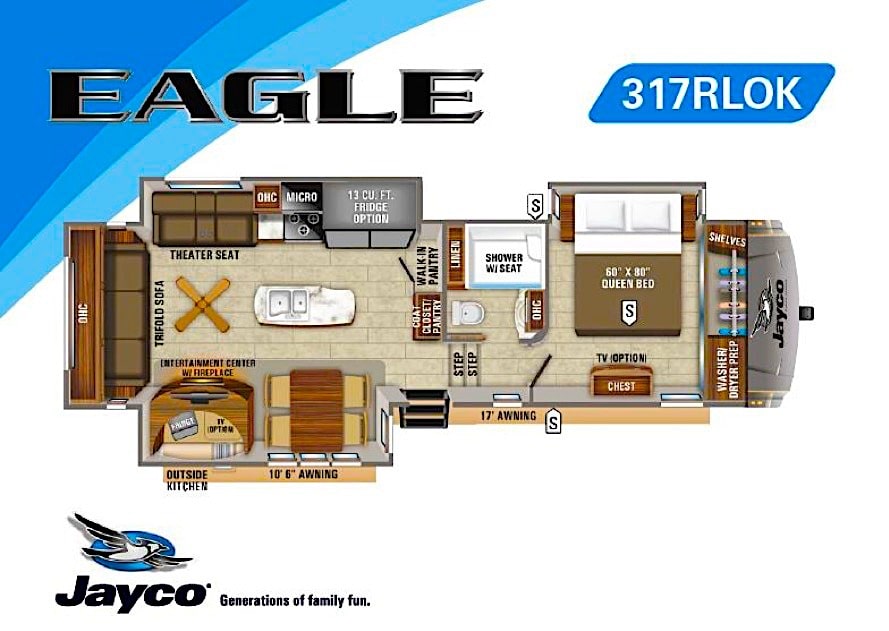
| OK | Outdoor kitchen |
| MS | Murphy Suite or another manufacturer-specific Murphy-bed layout |
These meanings are common, but they are not guaranteed.
A manufacturer may use the same letters differently, add its own brand-specific letters, or combine several abbreviations into one long model name.
So use the letters to narrow your search, but always open the actual floor plan before assuming you know what they mean.
Current RV Model Number Examples From Our Walkthroughs
Here are three current examples that show why you need to look at both the model code and the official specifications.
Jayco Jay Flight SLX 130BH
The BH means bunkhouse, which is helpful. But the 130 does not mean the trailer is 13 feet long. The current 130BH is 16 feet 1 inch overall.
This is exactly the kind of model number that frustrates us on a dealer lot. The letters help. The number does not tell us the true length.
Winnebago Access 18RK
The RK tells us this is a rear-kitchen floor plan. That part is straightforward.
But the 18 does not mean it is an 18-foot travel trailer. The current Access 18RK is 22 feet 6 inches long.
That is a four-and-a-half-foot difference, which matters when you are comparing tow vehicles, storage spaces, and campsites.
Airstream Atlas 25MS
This example is easier to decode. The current Atlas is approximately 25 feet long, and MS stands for Murphy Suite.
So sometimes the model number is genuinely useful. The problem is that you do not know whether you can trust it until you check the manufacturer’s specifications.
These are the kinds of details we point out in our RV walkthroughs because we review RVs by floor plan and livability, not just by reading the badge on the outside.
Some RV Letters Are Manufacturer-Specific
Not every abbreviation can be decoded from a standard list.
You will see model names with letters such as CM, XG, LE, XLT, SLX, XLS, and dozens of other combinations.
Some identify the floor plan. Others identify the trim level, construction package, regional version, or product series.
This is where older model-number guides can get buyers into trouble. They present every letter as if the RV industry follows one master code.
It does not.
For example, an K might suggest a king bed on one RV, while another manufacturer may use it as part of a kitchen-related code. An S may mean slide-out, a series name, or something completely different.
When the letters are not obvious, I do not guess. I look at the floor plan and the manufacturer’s current specification page.
What an RV Model Number Can Tell You
A model number can still be useful.
It can help you:
- Identify a specific floor plan within a product line
- Search dealer inventory for the layout you want
- Compare similar models from the same manufacturer
- Recognize common layouts such as bunkhouses or rear kitchens
- Find walkthrough videos, brochures, manuals, and owner discussions
Once Susan and I know we want to see a rear-kitchen model, searching for RK can save us time.
But I would only compare model numbers within the same product line. An 18 from one manufacturer may be completely different in size from an 18 built by another company.
What an RV Model Number Does Not Tell You
Do not assume the model code tells you:
- The exact overall length
- The box or living-space length
- The unloaded vehicle weight
- The gross vehicle weight rating
- The cargo carrying capacity
- The hitch or pin weight
- The number of axles
- The true sleeping capacity
- The tank sizes
- Whether your tow vehicle can safely pull it
Those numbers need to come from the official specification sheet and the labels on the actual RV.
This is especially important because RV specifications and floor plans can change from one model year to the next without a major change to the model name.
Why the Real RV Length Matters
The difference between a model number and the real length is not just trivia.
It can affect where you can camp, where you can store the RV, and how comfortable you will be towing or driving it.
Some campgrounds list maximum RV lengths. Some roads leading to campgrounds have tight curves, narrow lanes, or length restrictions. Your driveway, HOA storage lot, or paid storage space may also have a firm limit.
A buyer who assumes an 18RK is 18 feet long could be surprised when the actual trailer is 22 feet 6 inches.
That is why I keep saying the same thing: never shop by the badge alone.
How to Verify an RV’s Actual Length
Here is the process I recommend when you are shopping:
- Check the manufacturer’s website. Make sure you are looking at the correct model year and exact floor plan.
- Look for overall or exterior length. Do not confuse it with box length, interior length, or awning length.
- Check the RV’s specification label. The label on the actual unit is more important than a generic dealer listing.
- Ask the dealer to show you the official spec sheet. Do not rely only on someone’s memory.
- Measure the RV when necessary. This is especially smart with a used RV that has a rear cargo rack, spare tire, ladder, or other add-ons.
For a travel trailer, measure from the front of the coupler to the farthest permanent point at the rear.
For a fifth wheel, verify how the manufacturer measures the front cap and rear equipment.
For a motorhome, include permanent exterior equipment that affects the space you need.
Where Can You Find the RV Model Number?
The model number may appear in several places:
- On the manufacturer’s data or certification label
- Near the entry door or on an exterior sidewall sticker
- Inside a cabinet or wardrobe information sheet
- On the title, registration, or purchase paperwork
- In the owner’s manual or original brochure
- On the dealer’s window sticker or specification sheet
The exact location varies by manufacturer and RV type.
Also, do not confuse the model number with the VIN. The VIN identifies the individual RV. The model number identifies the floor plan or version.
How We Shop an RV Show or Dealer Lot
When Susan and I walk an RV show or dealership, we take a photo of the model badge and the specification sheet.
That gives us a record of the exact model, actual length, weight, and floor plan.
I recommend keeping notes on your phone with:
- Manufacturer and product line
- Exact model number
- Overall length
- GVWR and cargo capacity
- Bed size
- Bathroom type
- Number of slides
- What you liked
- What you did not like
After walking through ten or twenty RVs, they start to blend together. A model number by itself will not help you remember whether the bathroom was too small or the bed was hard to access.
That is also why our YouTube reviews focus so much on floor plans and livability. The badge may help you find the RV, but the layout determines whether you will enjoy owning it.
Common Mistakes Buyers Make With RV Model Numbers
The biggest mistakes are easy to avoid:
- Assuming the model number is the exact length
- Assuming the same letters mean the same thing across every brand
- Using model numbers to estimate weight or towing requirements
- Comparing two brands only because their numbers look similar
- Looking at specifications for the wrong model year
- Confusing a trim-level code with a floor-plan code
I understand why buyers make these mistakes. The RV industry does not make this simple.
But once you know the model code is only a starting point, the confusion gets easier to manage.
Final Thoughts
RV model numbers and letters can help you search for the floor plan you want, but they are not a universal language.
The letters often give you useful clues. BH usually means bunkhouse. RK usually means rear kitchen. RB usually means rear bathroom.
The numbers are much less dependable.
A Jayco 130BH is 16 feet 1 inch long. A Winnebago Access 18RK is 22 feet 6 inches long. An Airstream Atlas 25MS is close to 25 feet.
Three model numbers. Three different approaches.
So use the model name to begin your research, then verify the actual floor plan, overall length, weight, and specifications before making any buying decision.
The badge tells you what to search for.
The specification sheet tells you what you are actually buying.
Related Reading
How to Choose an RV Floor Plan You Won’t Regret
Average Travel Trailer Length — Yes, It Matters
30 Questions to Ask When Buying an RV: New or Used
We also review RVs by floor plan and livability every week on the RVBlogger YouTube channel.
Mike Scarpignato – Bio
Mike Scarpignato founded RVBlogger.com with his wife, Susan, in 2018 to help new and experienced RVers make better decisions about buying, owning, and traveling in an RV.
Mike has decades of camping experience and has traveled extensively in both a Gulf Stream Conquest Class C and a Thor Challenger Class A motorhome. He and Susan spend much of the year on the road, attend RV shows, visit dealerships, and tour RVs across the country.
Through RVBlogger.com and the RVBlogger YouTube channel, Mike shares practical, first-hand advice about RV buying, floor plans, ownership, maintenance, gear, campgrounds, and the RV lifestyle.